Financial Planner
Introduction
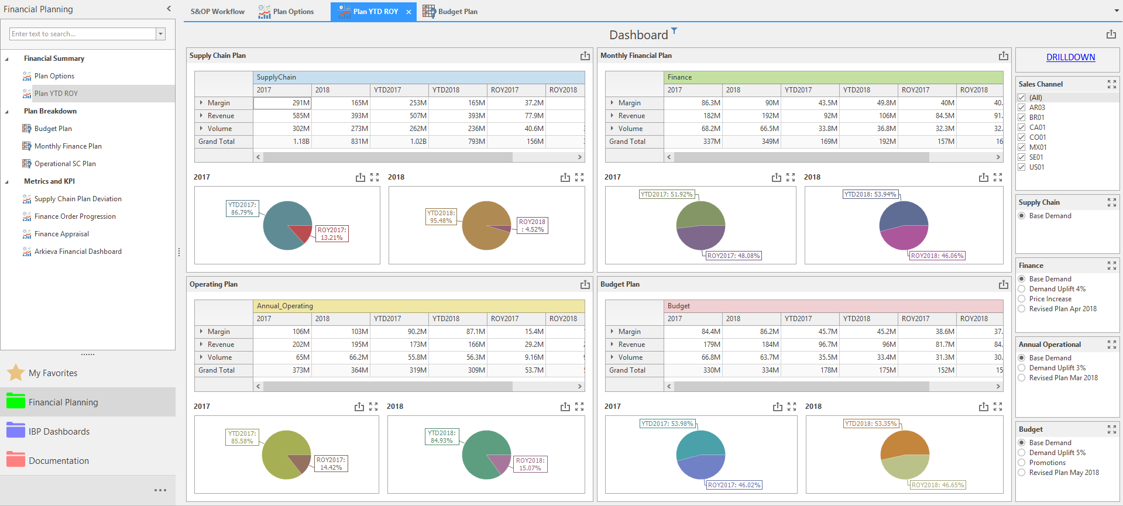
Increasingly, our customers would like to tie-in financial metrics to their operational plans. To accomplish this, we have incorporated strategic benchmarking into the Arkieva platform so that we can design the operational supply chain configuration to reflect a company’s strategic direction.
The Arkieva Financial Planner provides an integrated model for connecting financial or strategic plans to tactical or operational plans, track key financial metrics, and create a collaborative process for finance and operational teams.
Arkieva Financial Planner is an integral part of the S\&OP suite that enables seamless monetization and extends the framework for financial forecasting and bespoke modeling. It equips planning teams to visualize uncertainties from a business context and helps drive decisions.
Integrate financial planning with demand and supply plans to create a synergized S\&OP process that helps you meet organization goals.
Role of Finance in S\&OP
To define whether finance has a role in the S\&OP process, we first need to understand how a standard S\&OP behaves.
An S\&OP process is essentially a monthly set of recurring activities which can be grouped into three distinct planning functions. At a high level this is what an S\&OP process looks like:
S\&OP Process Overview
Generating Demand Plan
- Analyzing historical sales data for any outliers.
- Modeling supply chain events.
- Generating a baseline statistical forecast.
- Providing the baseline into a collaborative platform where sales people and business managers can provide their market intelligence.
- Generating different versions of the forecast.
Demand Review Meeting\ After generating the demand plan, the next step is to bring all this information to a Demand Review Meeting, where all involved stakeholders will make plan decisions going forward. This plan is called an Unconstrained Demand Plan, meaning that assuming we have infinite capacity in the marketplace, how much can I potentially sell into the market.
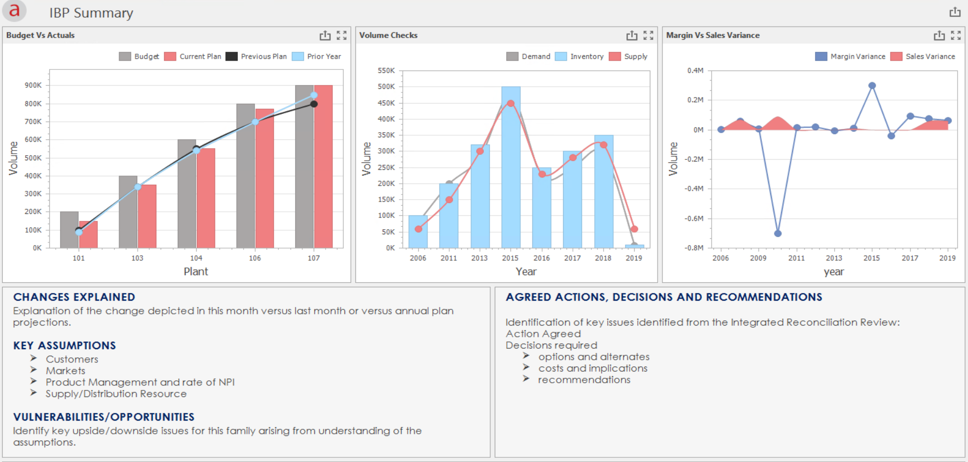
Below is an example of an Arkieva Dashboard for our Demand Review Meeting:
- In the top left section we are tracking Budget Vs Actuals, where the gray bar represents our budget, and the salmon colored bar represents our current plan. We can also compare against what was the Previous Plan and the Prior Year plan.
- The middle section represents our Volume Checks where year over year we're checking our Demand Vs Inventory Vs Supply.
- On the right side we have year over year analysis of our Margins and Sales Variance.
- It is also important to capture the agreed actions, the assumptions and the risk associated with each plan. That is is represented in the bottom half of the dashboard. Working with our customers, they provided us feedback that one of the most critical and the difficult parts of an S\&OP process is to follow through on previously agreed tasks and decisions, so a dashboard like the one below would enable you to make sure that you don't lose track of those actions.
Generate Supply Plan
Next we will generate the supply plan to see how realistic our forecast will be going forward. Generating the supply plan will add in real life constraints, allowing us to check our unconstrained demand plan against capacity limits. Some examples include raw materials constraints and availability, vendor contracts that must be met, or inventory storage limitations.
Supply Review Meeting\ Considering these constraints that may play into our supply chain, the next step in the S\&OP process is to create several 'what-if scenarios' and bring all this information to your different stakeholders in a Supply Review Meeting. Your stakeholders can then collaborate and agree on discussions for an official supply plan.
Generate Consensus Plan
After the supply review meeting, our next step in the S\&OP process is to Generate a Consensus Plan. This consensus plan will cover the next 18 or 24 months.
S\&OP Meeting\ In the S\&OP meeting, management will make decisions on what the plan will be going forward. To reach a decision, we must analyze our historical plans, look at alternatives, discuss our different options, and look at metrics.
The types of questions that will be asked during these meetings will revolve around dollarization or monetization of the plan, and also more nuanced questions around sensitivity.
- 'What is the role of finance in this complex supply demand balancing act?'
- 'How does this plan translate to revenue; how does it impact my bottom line?'
- 'How will the plan affect my margins?'
- 'Is this plan the most profitable option?'
- 'What is the gap to the budget that we previously prepared?'
- 'How are we tracking against our year-end inventory goals?'
- There may be more complex questions such as 'If we move our production from Mexico to the Philippines, how is it going to impact our bottom line, will this give us some efficiency improvements?'
📘 Note
These typical questions establish there is a role for Financial Planning, or monetization of our S\&OP plan.
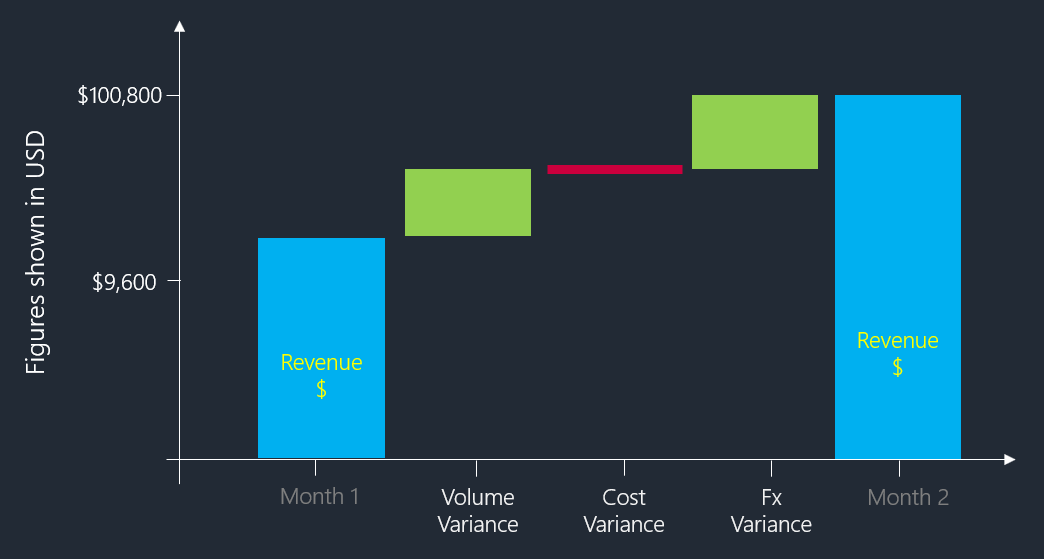
Below is an example of an advanced scenario discussing sensitivity and risk analysis. The left side of the report is a Bridge Chart.
- The Blue Columns represent the revenue delta from Month 1 to Month 2.
- The positive and negative of various factors are represented in the Green and Red bars in the middle of the Bridge Chart.
In this example the volume growth and the favorable exchange rate provide growth from Month 1 to Month 2, but the Red bar represents the cost or the raw material purchased, causing the production costs to go up between Month 1 and Month 2, resulting in the revenue going down.
Sensitivity and Risk Analysis
- Impact of Currency (Fx) volatility
- Impact of Price changes
- Impact of Raw Material Cost swings
- Impact of New Product Introduction and Promotions
Financial Planning Stages
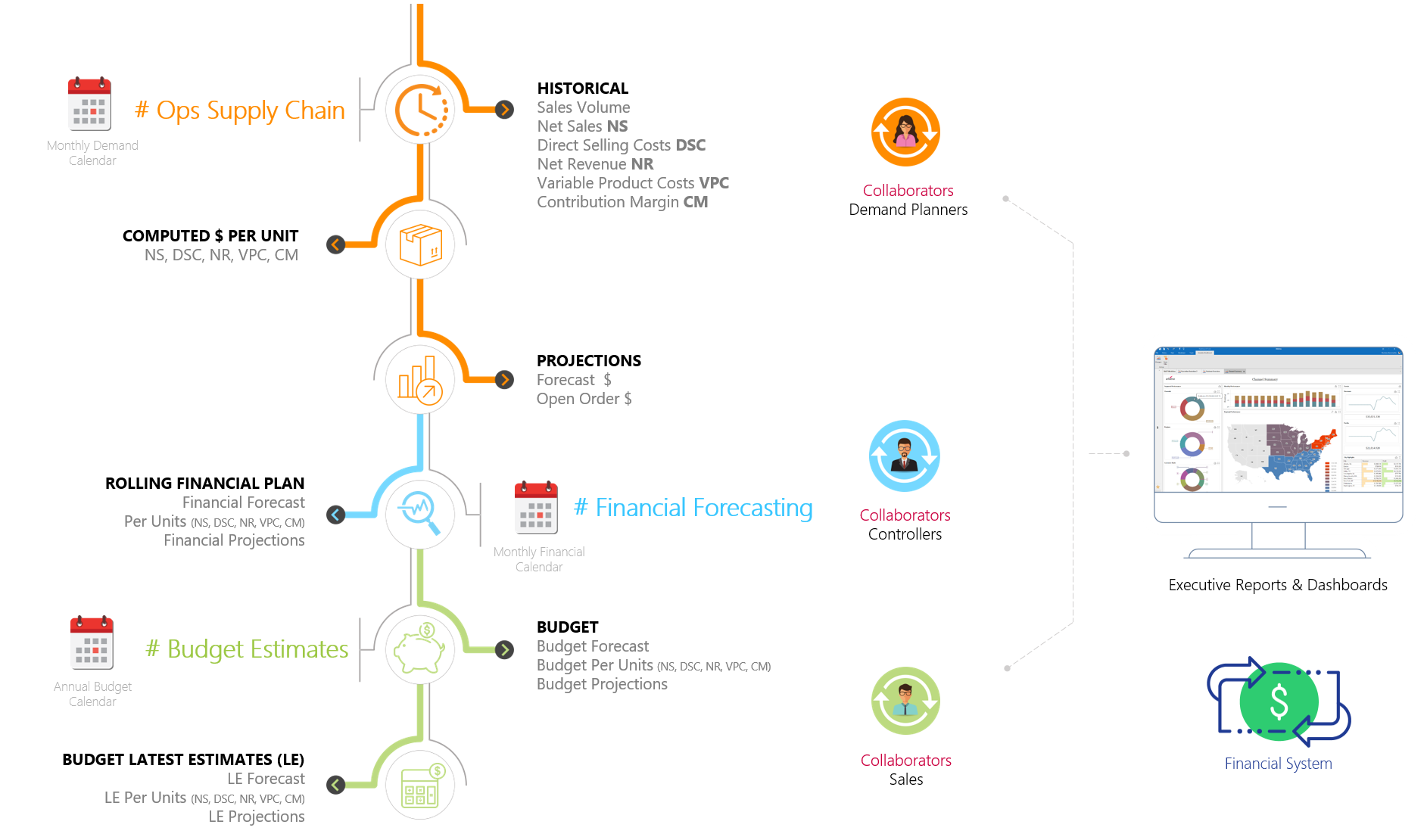
How do we integrate finance into your S\&OP process? We believe in a very phased modular approach where the business gets value from each implementation. There are three distinct stages of integration with financial planning: Operational Supply Chain, Financial Forecasting, and Budgeting and Latest Estimates.
Operational Supply Chain
The first layer of integration is the operational supply chain, this is the layer where you have the demand planners, the sales management team, and the business managers all collaborating to provide market intelligence.
This is the stage where you have all your historical data being imported into the system so the top left section represents all the historical data that is coming in including your net sales, the various cost, direct selling costs, net revenue, historical net revenue, and your historical margins.
The system is able to make some recommendations on what your calculated per units will be, by per units we are referring to net sales per unit, what is your BBC per unit. now these are just examples of the types of cost and price that you can bring in, but there are most costs that are applicable to you in your business, but the system makes those computed recommendation and using the forecast in the open orders you're able to make projections for what is your revenue going forward for the next 24 months. What is your net sales going out for your 24 months using the calculated per units and the projected forecast that is coming out of your Arkieva demand planning system.
Operational Supply Chain breakdown
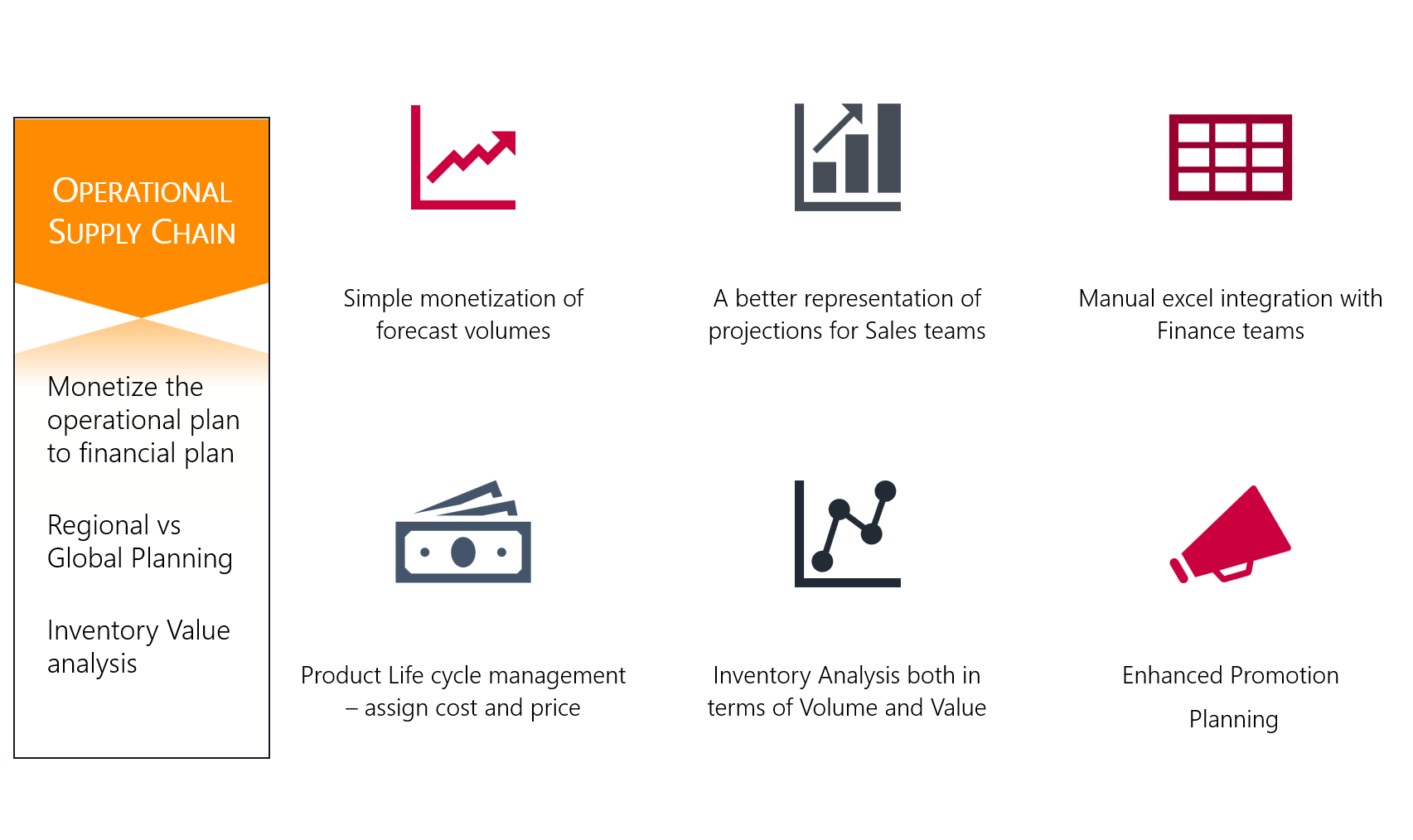
- This is the first and mandatory stage for any monetization of your supply chain numbers. This provides simple monetization of your forecast volume.
- Sales teams often ask the question, 'What does this plan mean in terms of my revenue?', and having monetization capability within the supply chain layer will give you confidence and also allows sales people to collaborate more effectively in the overall S\&OP process.
- At this stage you may want to consider some manual integration with finance team using Excel.
- Another important aspect is Product Life-Cycle management. Typically we have product cannibalization, or new product introductions and new combinations, and these tools will provide the capability to assign cost and price so you can perform some analysis around it.
- You also need the ability to do some inventory analysis, not just in terms of volume but also inventory value projections going out for the next year or the next 24 months. Typically around October/November time-frame companies are focused on reducing their overall inventory and having this monetization capability will be quite powerful.
- If you're in the retail space promotion planning capability also becomes enhanced when managing cost prices and budget estimates.
Financial Forecasting
The next layer of integration is Financial Forecasting. Financial teams typically operate independently of the supply chain group, but they rely quite heavily on up-to-date forecast information from the operational supply chain group. They often want to understand what are some of the newer risks and any new opportunities that they should be aware of.
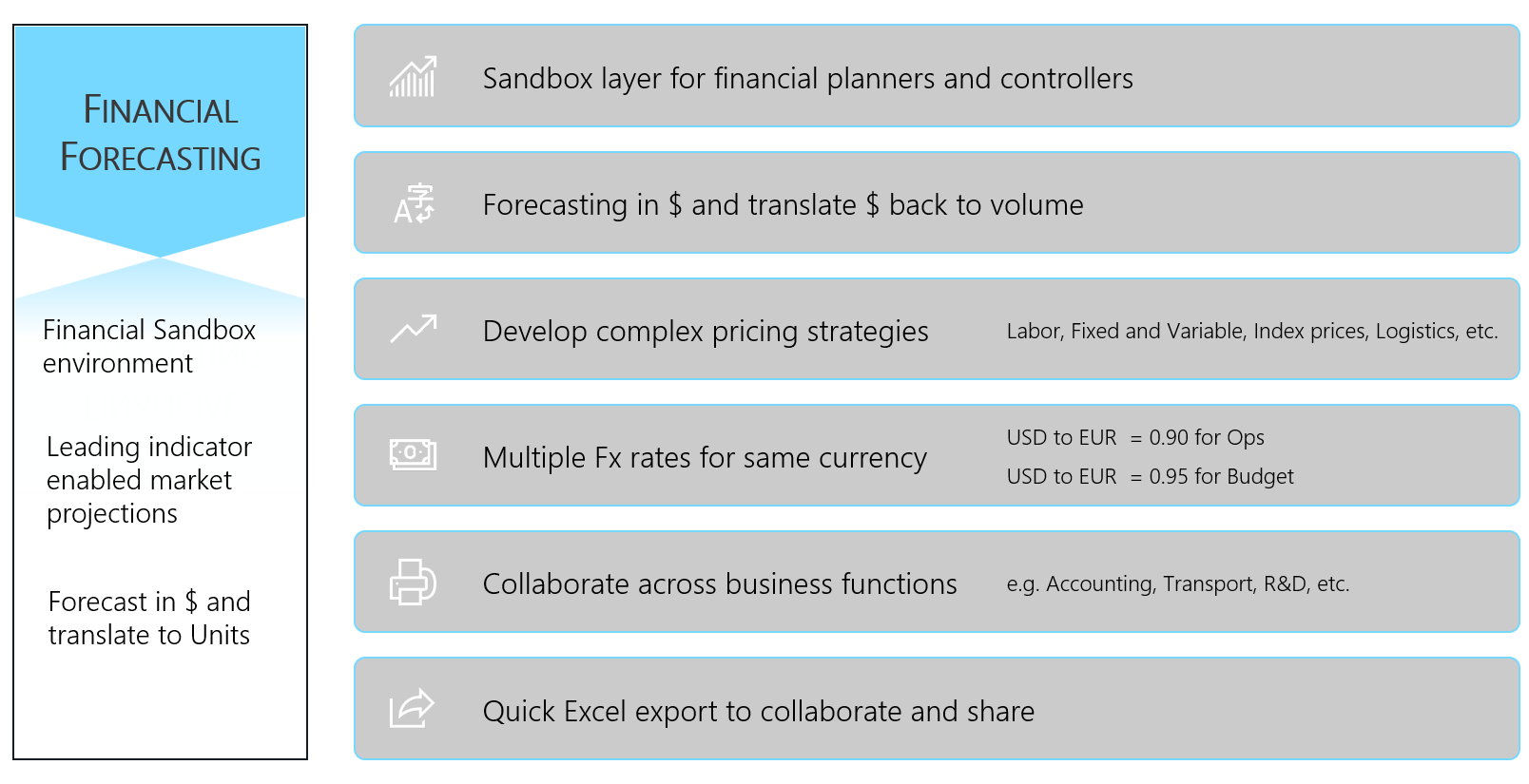
- Arkieva planning tools enable a sandbox layer where financial planners can collaborate and provide their market intelligence.
- The ability to forecast in dollars and translate it back in terms of volume.
- Ability to develop complex pricing strategies. The prices could include a variety of variables including labor cost, fixed and variable prices, index prices, logistic cause, raw material production, all kinds of costs that play into our pricing strategy.
- Having the flexibility to work using multiple currencies, and also for each currency you may need to have different exchange rates. From an operational standpoint, conversion from USD to Euro could be 0.9, but for budgeting purposes you may want to choose a static exchange rate of 0.95.
- Providing seamless collaboration capabilities across different planning functions from accounting to transport, or any department that is involved in the financial planning aspect.
- Collaboration by using Excel to send information back and forth and integrating feedback from different groups.
One further consideration in the financial forecasting functionality is the leading indicators where you have market projections, GDP, better projections, and external indicators that have a direct impact on your business.
Budgeting and Latest Estimates
Budgeting is the third and final layer of integration. This layer is where different sales stakeholders and other external stakeholders will provide market intelligence on what is going to be the budget for the next year. This can also include budget re-forecasting, also referred to as latest estimates.
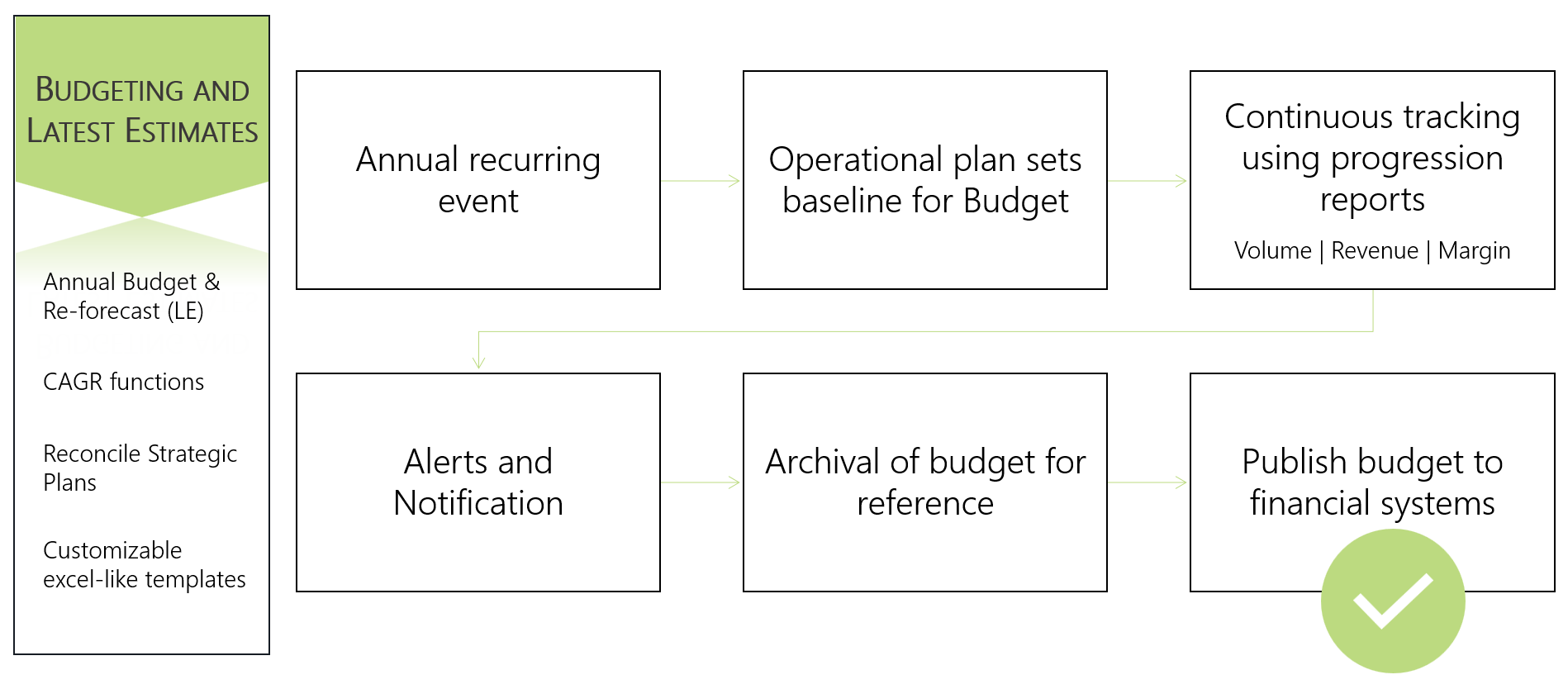
Companies often struggle with developing and reconciling the budget. With so many stakeholders involved one of the key challenges with their annual budgeting process is the mix; planning is typically done at an aggregate level and typically when you want to compare against the budget from an operational standpoint, the mix really matters. It is really important from an operational standpoint to know how does this high level budget break down into the individual skills.
You also need this to be running as an annual recurring event and you also need the flexibility to ensure that if yours is a global organization, not all regions will start the budgeting process simultaneously, or not all business lines will have the budgeting process at the same time. You need the flexibility to ensure the first group does budgeting on a certain day, the second group does it at a different date.
Continuous tracking using progression reports in the form of both volume, revenue, and margin should also be provided. And it is very important for you to have alerts and notifications such that you stay ahead of any disruption. Typically in a budgeting process you also need the flexibility to archive your budget and also typically would go through multiple revisions of your budget so the tool should be able to provide that flexibility.
And finally at the end of the day any planning tool that you use will not become the system of record. If you do have another financial tool, the system should be able to publish that information back to your external financial planning tool.
Custom Modeling
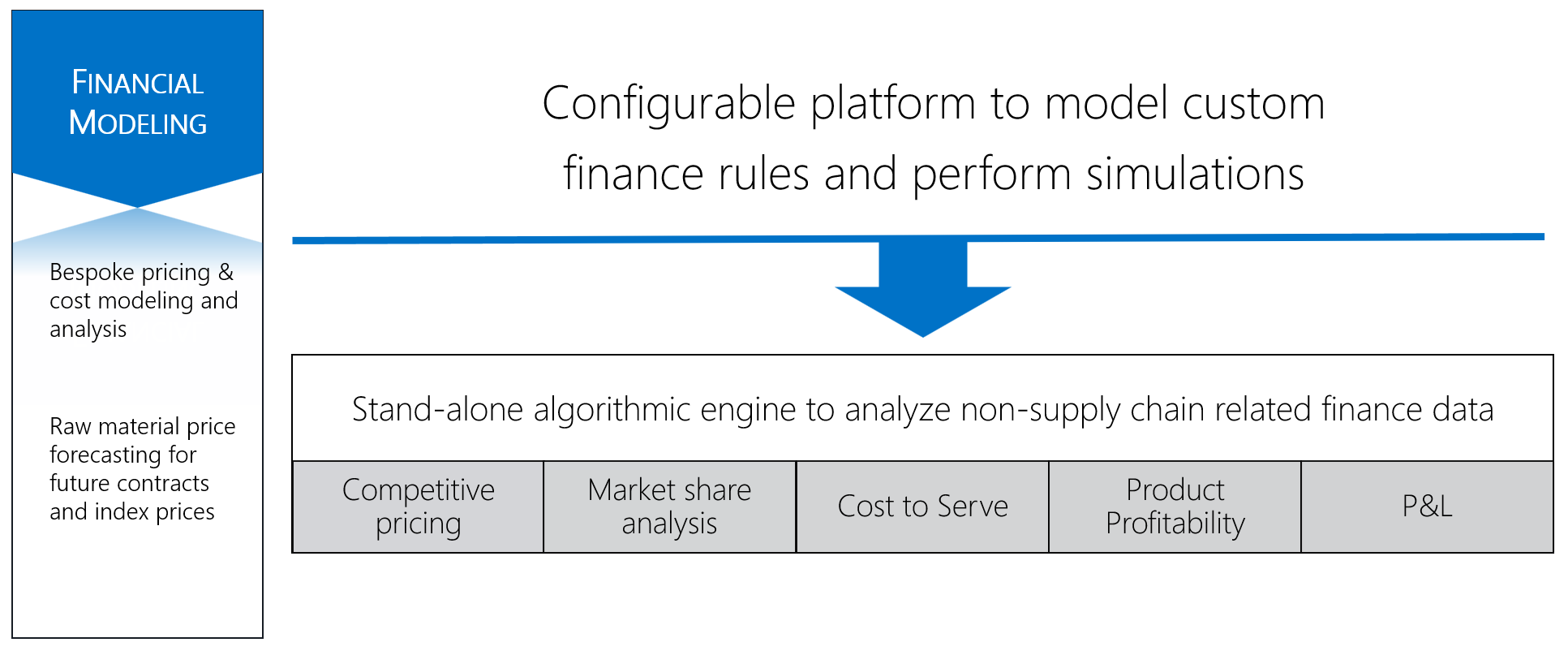
Occasionally companies will have the need to perform one-off analysis that won't necessarily fit into the S\&OP wheel house. Examples could be if you have a key raw material that goes into every single finished food that you sell in the marketplace. Even a 1% increase in cost of that key raw material could have add a significant impact to your margins. Some companies will require the ability to do some simulations around this possibility. 'What if the raw material price goes up, what would be the impact of my bottom line?'
- Another analysis that is also possible is developing complex pricing strategies based on market share analysis.
- Perform complex analysis in terms of what pricing you should be providing by purchasing external data from companies, which provides what is the capacity in the marketplace.
- Perform Cost to Serve network analysis
- Develop P\&L directly inside the planning tool that you select.
Monetized Forecast Metrics
Examples of forecast metrics are typically WMAPE, Bias, MAD, and several variations of these. Some of the common challenges with these volume based metrics is they are not very well understood by teams outside of the supply chain. Oftentimes the trade-off decisions are missed because the impact of the forecast error is unknown or is not understood by the team. How do you translate the value of the accuracy such that it adds business value is also not quite clear. And it rarely leads to any constructive discussions and it really does not drive any decisions. These are some of the shortcomings of the volume based metrics that are widely used in the industry.
Now based on the principles that we shared earlier using using revenue and cost, we will build upon those principles and show the impact of forecast error on revenue, and show the impact of forecast error on our inventory, and ultimately how it impacts our margins.
Monetized forecast metric
Below is an example of a metric based on an article by Marko Pukkila at Gartner. We will refer to the columns as column numbers 1 through 12, and on the left side we have the list of items A through H. Columns 1 and 2 represent the Forecast and the Actuals for each one of the items, Column 5 represents the Error, and Column 6 represents the Absolute Error for each one of the items in our portfolio. Column 7, 8, and 9 represent the Unit Price, the Unit Cost, and the Unit Margin that you would be making for each one of these products.
If we were to look at this example strictly from a demand planning perspective which is just based on volumes, then as a planner we would go to column 6 and sort it based on the highest error. As you can see, the one with the highest error is item B. But if we do the same analysis using Revenue, item G has the highest error because the impact of the forecast error is roughly about 4 million. And even though from a forecast error standpoint, which is from a volume basis, it is only 11%. Management will often rather be interested in why we are missing 4 million in opportunities and how we go about fixing it versus simply looking at a percent error, which really doesn't tell you what is the impact to the business.
Mechanics of the Metric
Related Articles
Inventory Planner
The Arkieva Inventory Planner (IP) supports sustained inventory reductions by providing a comprehensive view of how stocks are serving customer demand. The Inventory Planner is closely linked with the Demand Planner and the Supply Planner. Reports ...Replenishment Planner
The Replenishment Planner is a multi-echelon planning solution that ensures that the right quantity and mix of products are shipped to the right location, at the right time. The Replenishment Planner uses a proprietary, sequential rule-based ...DRP
Introduction Positioning DRP in the supply chain planning landscape\ Supply chains are often composed of a complex distribution network. There is a need to move products across the different nodes of the network in order to satisfy the customer ...Forecast Performance Management
“What gets measured, gets managed.” There are a many alternatives on how to measure forecast accuracy. It does not matter too much how you define the KPI as long as: it is consistent, and it is understood by all stakeholders. Therefore, choose a set ...ATP, AATP, CTP and PTP
Available-to-Promise, Able-to-Promise, Advanced Able-to-Promise, Capable to Promise, Profitable to Promise: all are catch phrases describing different offerings that support the order commitment process. Such a proliferation of jargon makes it harder ...