Revealing the Mystery of Safety Stock
Understanding Safety Stock & Target Stock Calculations
Learn to calculate safety stock and other inventory targets in Arkieva.
{`
`}
Inventory: “Buffer Zone Dance” between Supply Folks and Demand Folks
Some Basics and When to “normal”
All of us experience the challenge of inventory every day – whether at home ( like how many cans of tuna to keep in the cupboard) or as a critical component of effective management of your demand supply network. Although being a critical component is constant, the amount of attention among the trade press and vendors occurs in a cyclical fashion, and 2015 was certainly a high point in the cycle.
A high level supply chain manager I knew referred to inventory policy as the Good, the Bad, and the Ugly – referring to the ability to meet client demand immediately; costs to hold inventory and potential obsolescence; and uncoordinated hording. In this post we want to reveal some of the mystery behind the safety stock calculation and identify the role of “normal”.
Most of us use equations or formulas without a full understanding of why they work, or more importantly when they work well and when they don’t. Not that we are not interested or do not consider it important, but the information is difficult to find and typically written in a way only certain members of the “math tribe” can understand.
There are members of this tribe that are bilingual, and we will reveal part of the mystery of the safety stock calculations with strange symbols. This knowledge puts you in a better position to evaluate consultants and software vendors.
Revealing the Mystery of Safety Stock Calculations for Inventory
Ice Cream Store – Rules of Replacing Inventory & Daily Demand\ The best way to take the mystery out of the “math” is to use a simple example. Often the members of the “math tribe” start with some examples on a white board and later create the equations with the strange symbols; erasing the white board to eliminate the incriminating evidence.
Our example business is a small ice cream store that only sells its famous vanilla ice cream in five gallon units. When the store needs to refill its supply of vanilla ice cream (in inventory speak - replenishment), the order can be placed at night after the store closes, and the new supply is delivered well before the store opens the next day without fail. The store can, if it wants to, reorder or replenish every night, every two nights … every 10 nights. In terms of quantity, the store can reorder between 1 and 9,999 units each time it places a replenishment decision.
In inventory terminology:
- The replenishment lead time (time between an order is placed and the order arrives) is 0. Why? The order is placed after the store closes and before it opens – 0 time in terms of meeting the needs of customers.
- The variability (uncertainty) of the lead time is also ZERO.\ The owner believes the probability of a certain demand on any day is as given in Table 1. For this example, we will accept is as given. The complexity of generating this information is a topic for another time.
Table 01: Probability of Each Demand
| Index | Demand | Probability (PDF) | Cumulative Probability (CDF) |
|---|---|---|---|
| 1 | 14 | 0.30 | 0.30 |
| 2 | 15 | 0.15 | 0.45 |
| 3 | 16 | 0.08 | 0.53 |
| 4 | 17 | 0.07 | 0.60 |
| 5 | 18 | 0.30 | 0.90 |
| 6 | 19 | 0.10 | 1.00 |
| Sum | 1.00 |
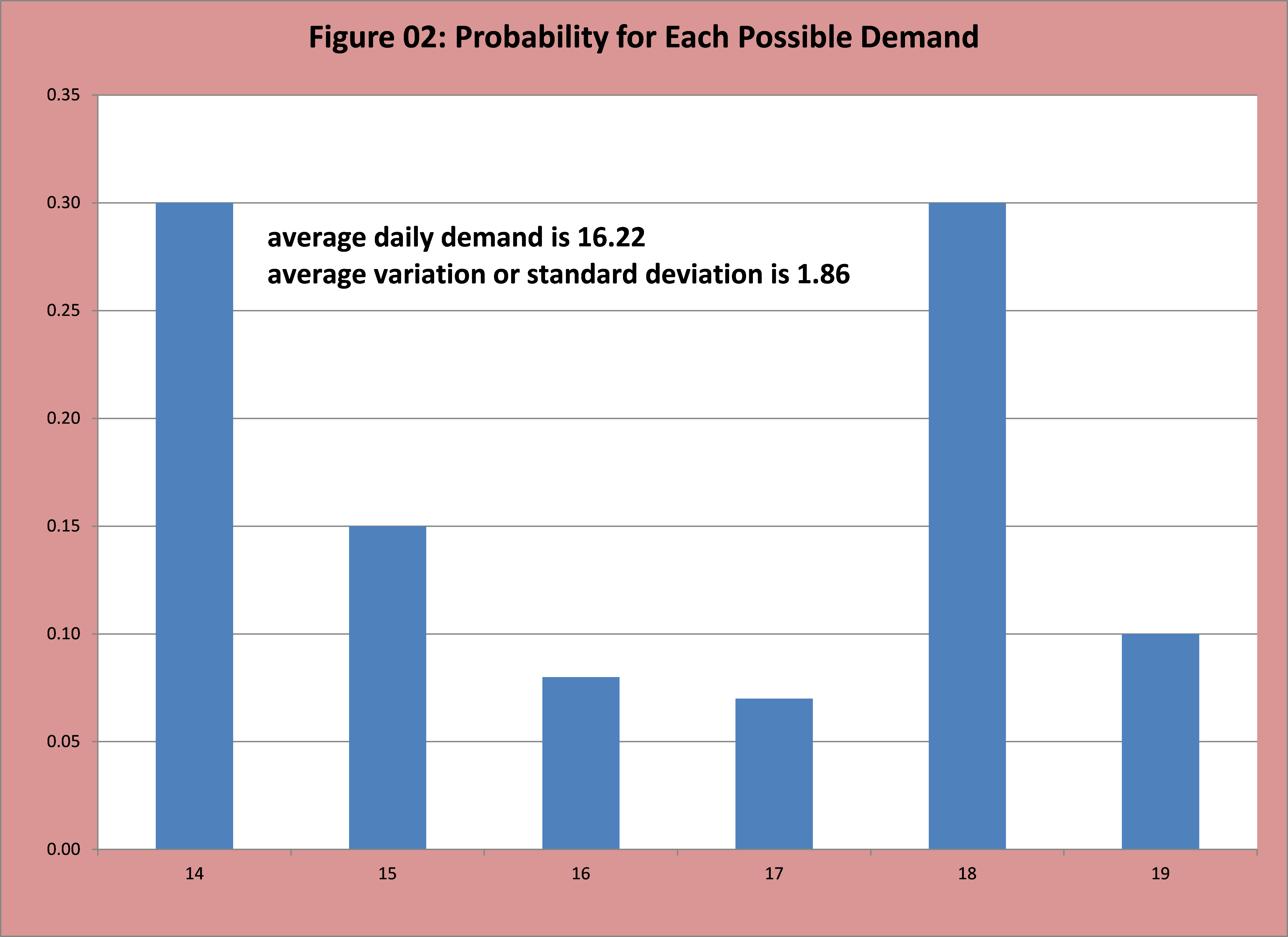
The Index column is the identifier for each of the six possible demands. The Demand column is the possible demand for a specific day, which is 14 to 19. Probability is the probability of exactly that demand on a given day. For example, the probability that daily demand is 16 is 0.08. Cumulative Probability is the probability of demand for a specific day is the value for that row or less. The probability that the demand is 15 or less is 0.45(=0.30 + 0.15) which equals the probability of demand for the day, which is 15 (p=0.15). The Sum row has the value 1; the sum of the probabilities for each possible demand must be 1. Figure 2 is a graph of the Probability Distribution Function (PDF); the probability of each demand.
Two natural questions are
- What is the average daily demand (called expected value in statistics)?
- What is the average variation in demand (called standard deviation in statistics)?
Table 2 shows the calculation for average demand or expected demand; the value is 16.22. That is if the demand for each day was independent of the demand from the previous day and the probability of demand did not change over time, and if we collected demand for many days (say 100,000, added them up and divided by 100,000), the value would be 16.22 (or very close). Here we have snuck in two other inventory terms:
- IID – independent and identically distributed.
- Stationary – the probability of demand does not change with time.
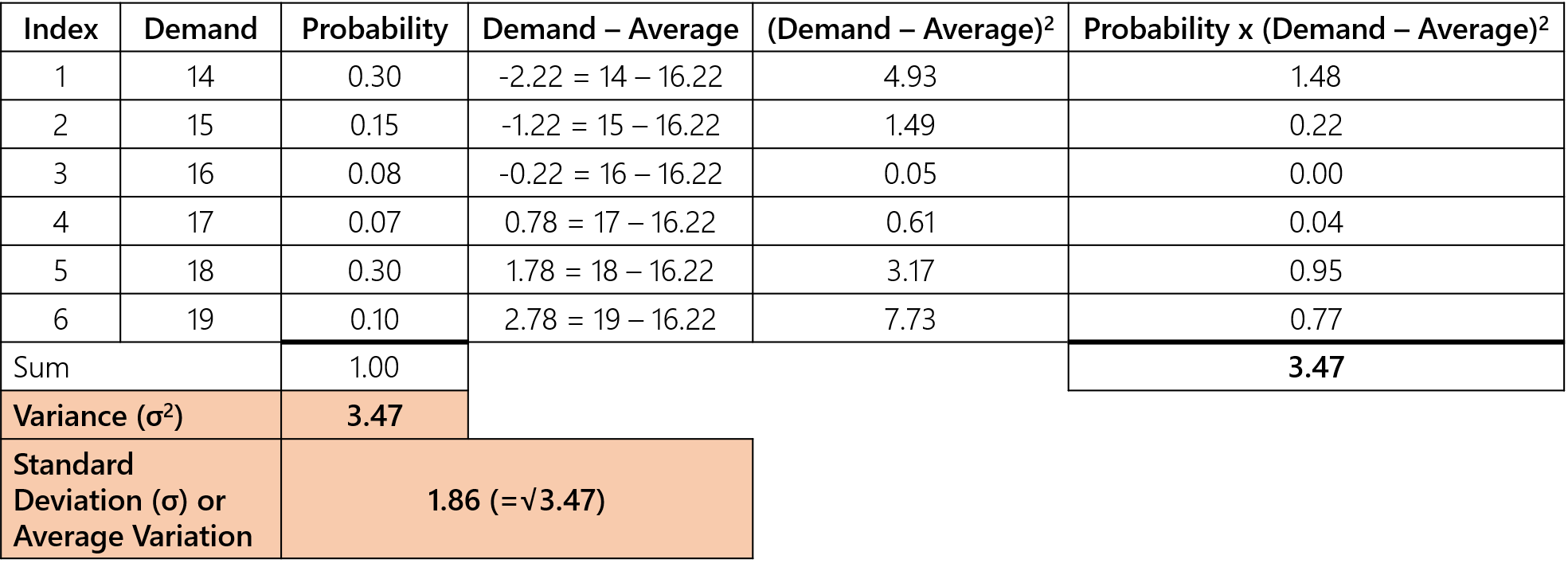
Table 3 has the calculation for the average variation of demand from the “average demand” (16.22 in this case) called the standard deviation. This calculation is a bit tricky, so let’s take a look in detail.
The first three columns are the same columns as Table 1 and Table 2. The fourth column, Demand – Average, is the heart of the calculation of average variation. Simply, for each demand we subtract the average demand (16.22 for this example). We see the value for row 1 is -2.22(=14-16.22), perfectly logical. If we want to know the variation around the average – find each difference.
Why not just multiply each difference by the probability and add them? Not so fast, that value is ZERO. Observe we have negative and positive values, we are interested in the size of the variation and therefore we need to make them all “positive’. We have two options:
- Use absolute value to convert negative to positive
- Square each value.
Long ago the math tribe decided to square the value. So we square each difference, (Demand – Average)2, and then multiply each of these values with the probability, Probability x (Demand – Average)2. This sum (3.47) is called the variance.
We need one more step to “undo” the squaring; we take the square root of the variation to get the standard deviation (1.86). Now you might ask, 'why not just use the absolute value?' There is logic in this. Later we will find the standard deviation has magical properties when we want to know the distribution of total demand over “n” (2, 4, 10, …) days.
Table 02: Calculation of Average or Expected Demand
| Index | Demand | Probability | Demand x Probability |
|---|---|---|---|
| 1 | 14 | 0.30 | 4.20 = 14 \* 0.30 |
| 2 | 15 | 0.15 | 2.25 = 15 \* 0.15 |
| 3 | 16 | 0.08 | 1.28 = 16 \* 0.08 |
| 4 | 17 | 0.07 | ***1.19 = 17* 0.07\*** |
| 5 | 18 | 0.30 | 5.40 = 18 \* 0.30 |
| 6 | 19 | 0.10 | * *1.90 \*\*= 19* 0.10 |
| Sum | 1.00 | 16.22 |
Table 03: Calculations of Average Variation - Standard Deviation
How Much Inventory to Have at the Start of the Day if We Reorder Every Night?\ In the previous sections we established the basic information about daily demand for vanilla ice cream and the rules governing replenishment of inventory. Now we want to examine how much inventory to have on hand at the start of a replenishment period – which is the number of days between reordering. We will start our examination with the simplest case: we reorder every night, which requires us to identify how vanilla ice cream to have on hand at the start of the day? Options are the values 14 to 19. To decide which one, we need a definition of success & failure:
- Success occurs when the amount of inventory on hand at the start of the day is sufficient to cover the demand for the day.
- Failure occurs when the demand for the day exceeds the amount of inventory on hand at the start of the day.
We now need the probability of success and failure for each inventory level option. The cumulative probability function (CDF) provides this information. If we set the inventory level at the start of each day at 15, then success occurs when the actual demand for the day is 15 or less (demand of 14 or 15). Failure occurs when demand for the day is more than 15 (demand of 16, 17, 18, or 19). The probability of success is the probability that demand less than or equal to 15, which is the CDF for 15 which is 0.45(=0.30 + 0.15). The probability of failure is {1 – CDF for 15} = 1-0.45 = 0.55 = 0.08 + 0.07 + 0.30 + 0.10
The term success and failure are intuitive and commonly used in probability and statistics. Alas, the inventory folks do not use the terms success and failure, but the terms:
- Fill rate – probability of success, the probability all demand for the day is met from inventory.
- Back order rate – failure - probability demand for day cannot be met from inventory.
The fill rate and backorder rate for each option (14 to 19) is given in Table 04. This captures the risk for each option the probability of having more ice cream in stock than needed to meet demand, or not enough. If starting the day with 17 units the chances of meeting all demand is 0.60 (fill rate) and not meeting all demand is 0.40 (backorder rate). What is the right inventory level? That depends on other factors such as the cost to hold inventory, real cost of lost sales, scrap policy (can left over ice cream be used tomorrow), etc. A topic for another time.
Table 04: Fill rate and Backorder Rate for each Inventory Level Option at start of day when replenishment occurs daily

Going from Desired Inventory Level at Start of Day to Safety stock\ In the previous section we reviewed the basics of deciding how much inventory to have on hand at the start of the day (replenishment period) including the concept of fill rate and backorder rate. There was no mention of safety stock!
Safety stock is defined as the quantity of inventory (in this case five gallon containers of vanilla ice cream) a firm decides to hold in inventory above the level of average demand. In our current example, it is the quantity in inventory at the start of the day. Table 05 extends Table 04 with the safety stock value with each option for inventory at the start of the day.
Table 05: Fill rate, Backorder Rate, and Safety Stock Level for each Inventory Level Option at start of day when replenishment occurs daily.

What if we replenish every other day (once every two days)\ Initially being able to replenish every day for the ice cream store seemed ideal, however having to be at the store a few hours before opening to unload the inventory from the truck quickly became a tiring. The store owner decided to replenish every other (every two days). This immediately generated a cascade of questions:
- How much inventory should be in the store at the start of the replenishment period (when the truck makes it delivery)?
- For a given inventory level at the start of the replenishment period what is the risk?
- What is the fill rate – probability at the end of the replenishment period (two days) the total demand can be met from inventory?
- What is the back order rate – probability at the end of the day demand cannot be met from inventory?
The key to answering these questions is creating the equivalent to Table 01 for two days. We need to know all possible total demands on the ice cream shop for a two day period and what is the probability of each of these values.
Finding the Total Demand on the Ice Cream Shop for Two days\ With the convenient “IID” assumption that:
- Probability of demand for any given is the same and follows Table 01.
- Demand for each day is independent of the demand on others days.\ This is an easy question to answer – which is why the math guys make this assumption and hide it in the fine print.
Let’s start with identifying the possible demand options. On day 1 the demand might be 14 and day 2 it might be any of the values 14-19. We could write these as a pair, where the first member of the pair is demand for day 1 and the second member of the pair is the demand for day 2. The pair (14/ 16) says the demand for day 1 is 14 and demand for day 2 is 16. The same pattern applies if the demand for day 1 is 15. There are 36 possible pairs. There are 6 options for day 1 (values 14-19) and the same six options for day 2. 36 = 6 x 6 =62, where 2 is the number of days in the replenishment period. The fancy math term for pairs is “tuple”.
Table 06 lists all of the 36 pairs. The row refers to demand for day and column for day 2.
Table 06: All Possible Demand Pairs (Day1/Day2) for Total Demand for Two Days
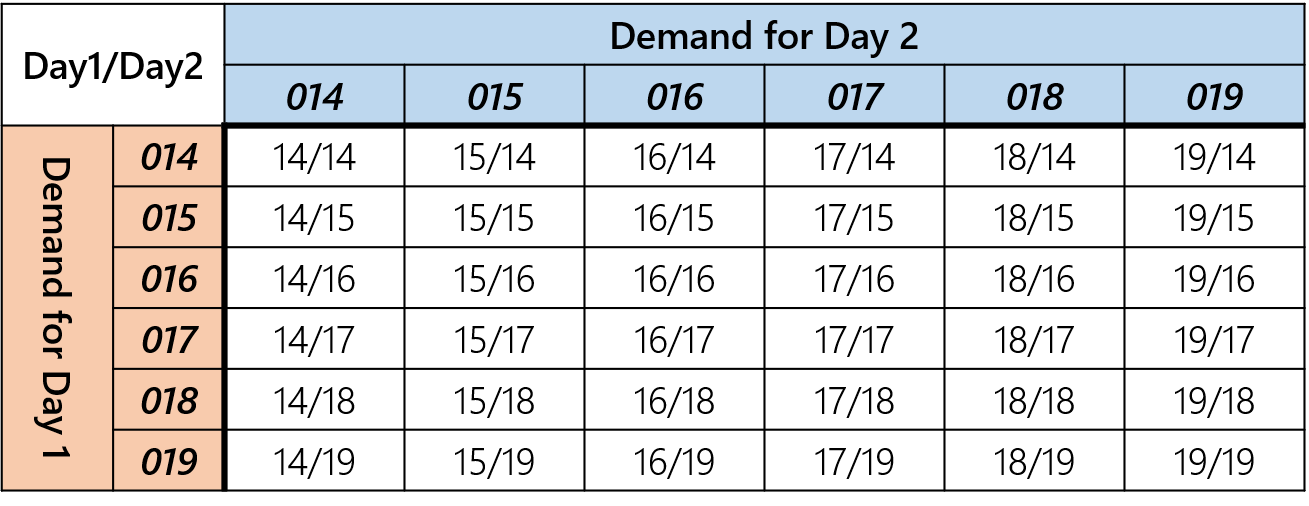
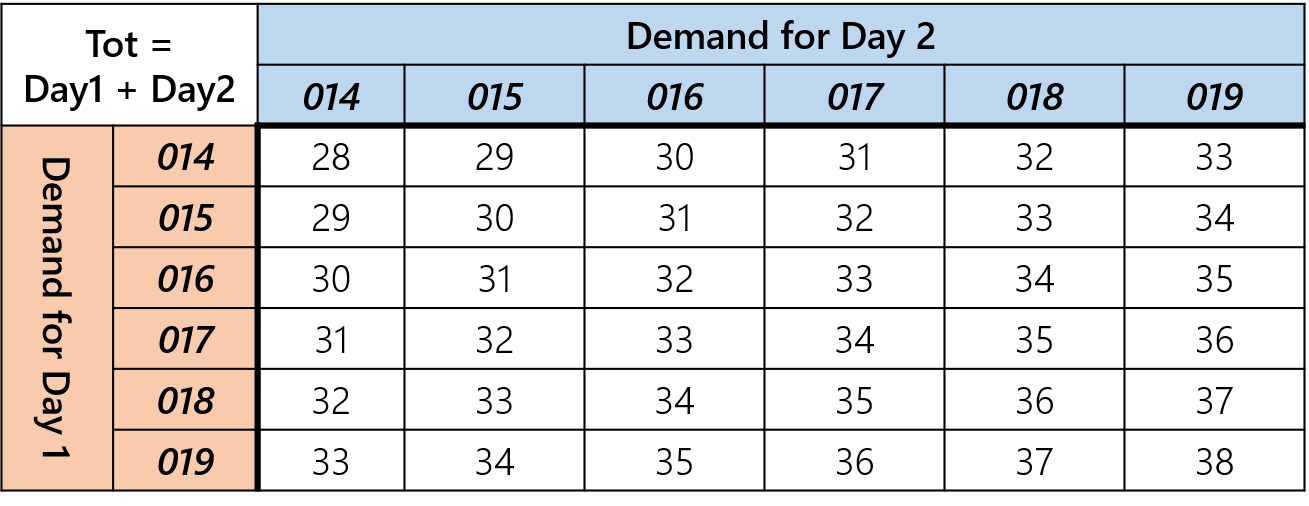
Observe the pairs (14/16) and (15/15). Each have the same total demand across two days. We only care about total demand for two days, how it is split between the two days is not important to us (right now). Table 07 provides the total for demand for each cell.
Table 07: Total Demand for Two Days for All Possible Demand Pairs
The second part of our quest is finding the probability for each demand pair. Again the “IID” fine print makes this easier. The probability for each pair is the probability of the demand on day 1 times the probability of demand on day 2. For example the probability of a demand of 16 is 0.08 (from Table 01) and the probability of a demand for 15 is 0.15. The probability of the demand pair (16 / 15) is 0.0120 = 0.08 x 0.15. Table 08 has all 36 probabilities.
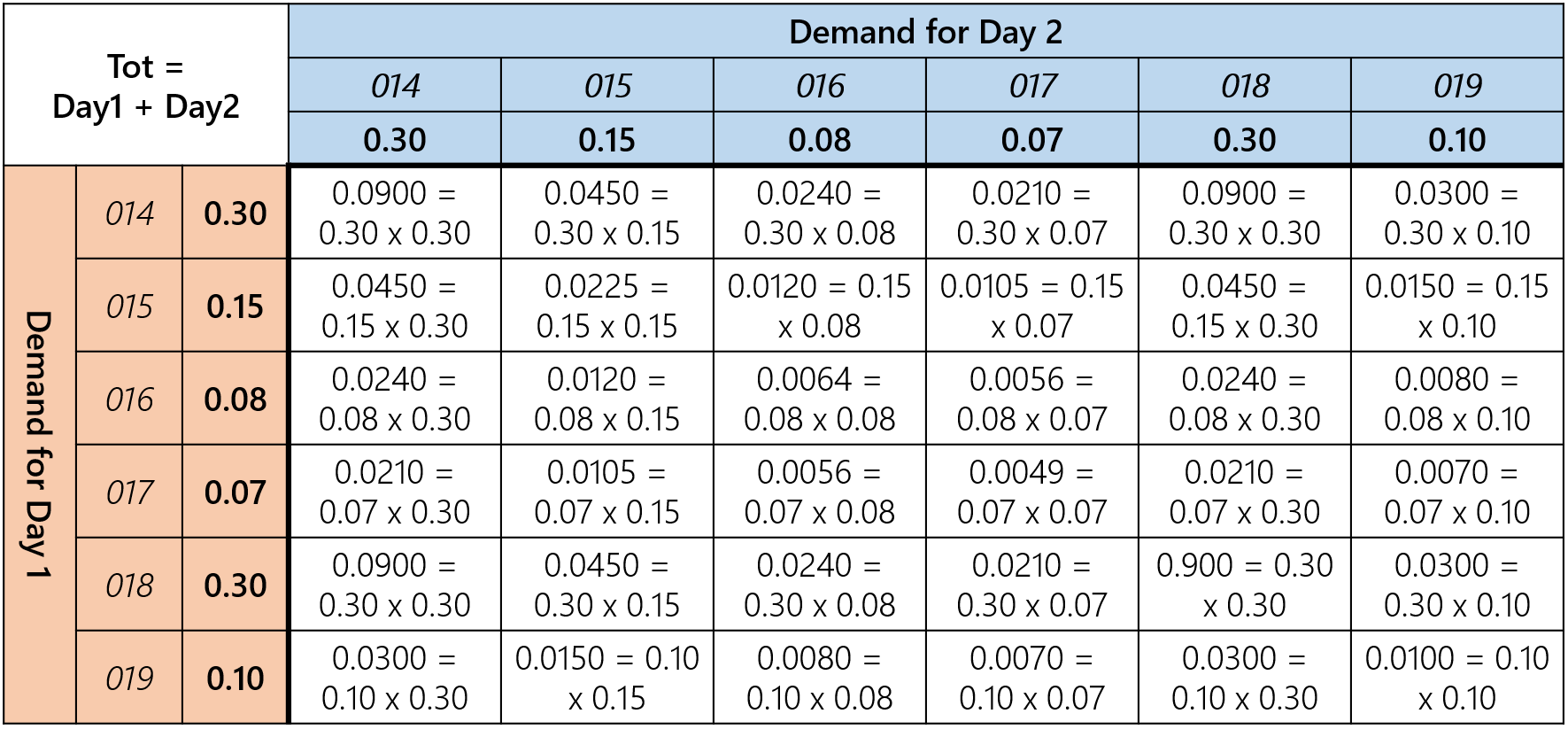
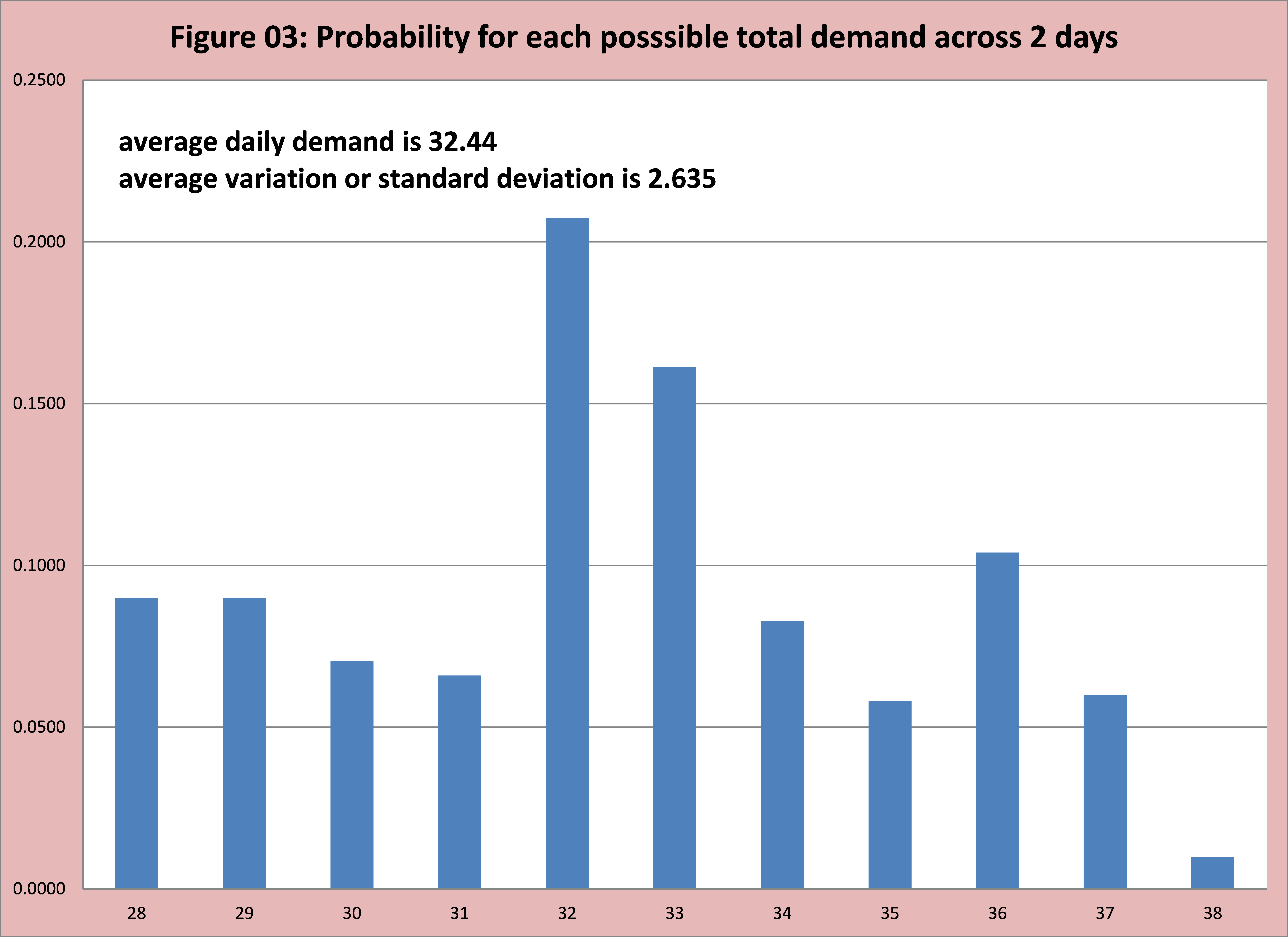
The last step to create the equivalent of Table 01 for the two day replenishment period is to aggregate the probabilities for demand pairs with the same total. For example, the demand total 29 occurs twice (pairs 14/15 and 15/14). Therefore the probability of total demand of 29 across two days is PRB(14/15) + PRB(15/14) = 0.0450 + 0.0450 = 0.0900. Table 09 has all unique total demand options for two days along with the associated probability for each possible total demand across the replenishment period of two days. Figure 03 plots the options and their probabilities.
Table 09 and Figure 03 has the probability distribution function for total demand on the ice cream store for the two day replenishment period. Additionally it has the average “total demand” for two days and the standard deviation for “total demand” for two days. Observe we have the term average and total next to each other – which can get confusing. From Table 09 on any given two day period the possible total demand at the store has 11 options; the values 28 to 38. If we collected 100,000 observations on total demand for two days replenishment periods and calculate their average, the value would be 32.44 (or close). 32.44 is the average total demand for a two day replenishment period. The average variation or standard deviation for this total is 2.635.
Table 09: All Possible Options for Total Demand for Two Days with Probability where Demand for One Day is Specified in Table 01

How might the store owner use the information in Table 09?\ Typically someone managing inventory wants to know the following for a specified fill rate:
- How much demand do I need in inventory at the start of the replenishment period?
- What is the safety stock required to meet this fill rate?
Remember fill rate is the probability of success that is the probability all demand during a replenishment period can be met from inventory in stock. The fill rate is the cumulative probability.
If the owner wants a fill rate of 0.90, then we select the demand value with the smallest cumulative probability value greater than or equal to 0.90. Table 09 tells us this value is 36 with a cumulative probability value of 0.93. If the owner has 36 units of vanilla ice cream in inventory at the start of the two day replenishment period, the chances of meeting all demand from inventory is 0.93. If the owner goes with 35 units, the fill rate drops to 0.826.
What is the safety for a fill rate of 0.90? Safety stock is the amount in inventory at the start of the replenishment period minus the average demand for this period. The average demand is 32.44, therefore safety stock is 3.56=(36-32.44). Sometimes safety stock is stated in per day level. For this example safety stock per day for a fill rate of 0.90 is 1.78.
Gift 1 from the Statistics god: Relationship between demand for 1 day & demand for 2 days\ The following fun facts from the statistics god will be helpful in the next few sections. They are provided without formal proof, but a computation example is provided.
- The expected total demand over “n” (in this case 2 days) is n x mean or average demand for a single day.
- In section 6 we observe 32.44 = 2 x 16.22
- The standard deviation of the distribution of total demand for n days is the square root of n times the standard deviation of the distribution of demand for a single day.
- In section 6 we observe 2.635 = √2 x 1.8632 = 1.4142 x 1.8632
Remember the measure for average variation is the standard deviation. The critical observation is the average total demand grows directly as n (number of days) grows. BUT, the average variation grows proportional to the square root of n.
A common measure to relate average variation to average value is the co-efficient of variation (CV) which is the standard deviation divided by the average. Specific to the relationship between demand for 1 day and total demand for n days, the following equations captures this relationship.
CV= (√n×1.863)/(n×16.22)
As n gets larger this value continues to get smaller. For this example when n=1, CV is 0.1149. When n=10, CV is 0.0363. CV is sometimes used to “measure” risk, we risk declines as n increases. We will also see as n increases the safety stock per day declines for the same fill rate.
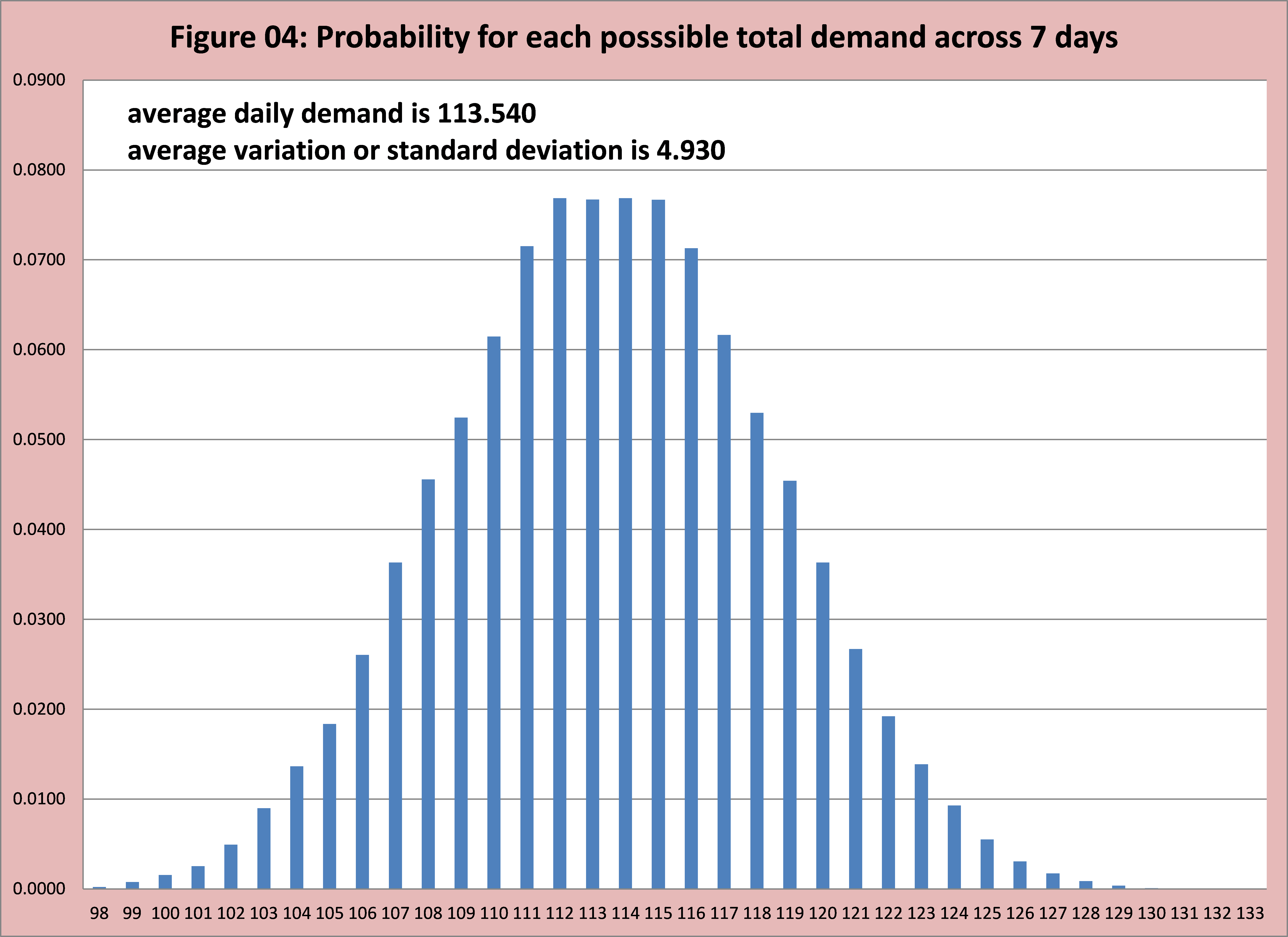
Finding the Total Demand on the Ice Cream Shop for Seven days\ Our ice cream shop owner has decided to take a full week off and wants to know the distribution of total demand for seven days to support a decision on how much inventory to have on hand at the start of the replenishment period. Extending the same logic as we did with two days, Table 10 has distribution of total demand for 7 days. Figure 04 graphs the distribution.
The average total demand for seven days is 113.540 and the standard deviation is 4.930. The CV value is 0.043. This table provides the core risk information for the owner to make a decision about how much inventory to have on hand at the start of the replenishment period.
Assume our owner still desires a replenishment rate of 0.90. Table 10 informs the store needs 120 units of vanilla ice cream in stock at the start of the 7 day replenishment period and will achieve a fill rate of 0.9192; 92% of the time all demand for these seven days will be met from stock.
What about safety stock. The average total demand for seven days is 113.54. The safety stock is 6.46(=120-113.54). The safety stock per day is 0.923 = 6.46/7. This is lower than the safety stock per day for the two day replenishment period.
Gift 2 from statistics god: as n gets large, all paths lead to normal\ If we compare the basic shape of Figure 04 with the shape of Figure 01, we see the irregular shape (called multi-modal, multiple high peaks) found in Figures 02 and 04, is beginning to morph into a “normal” shape.
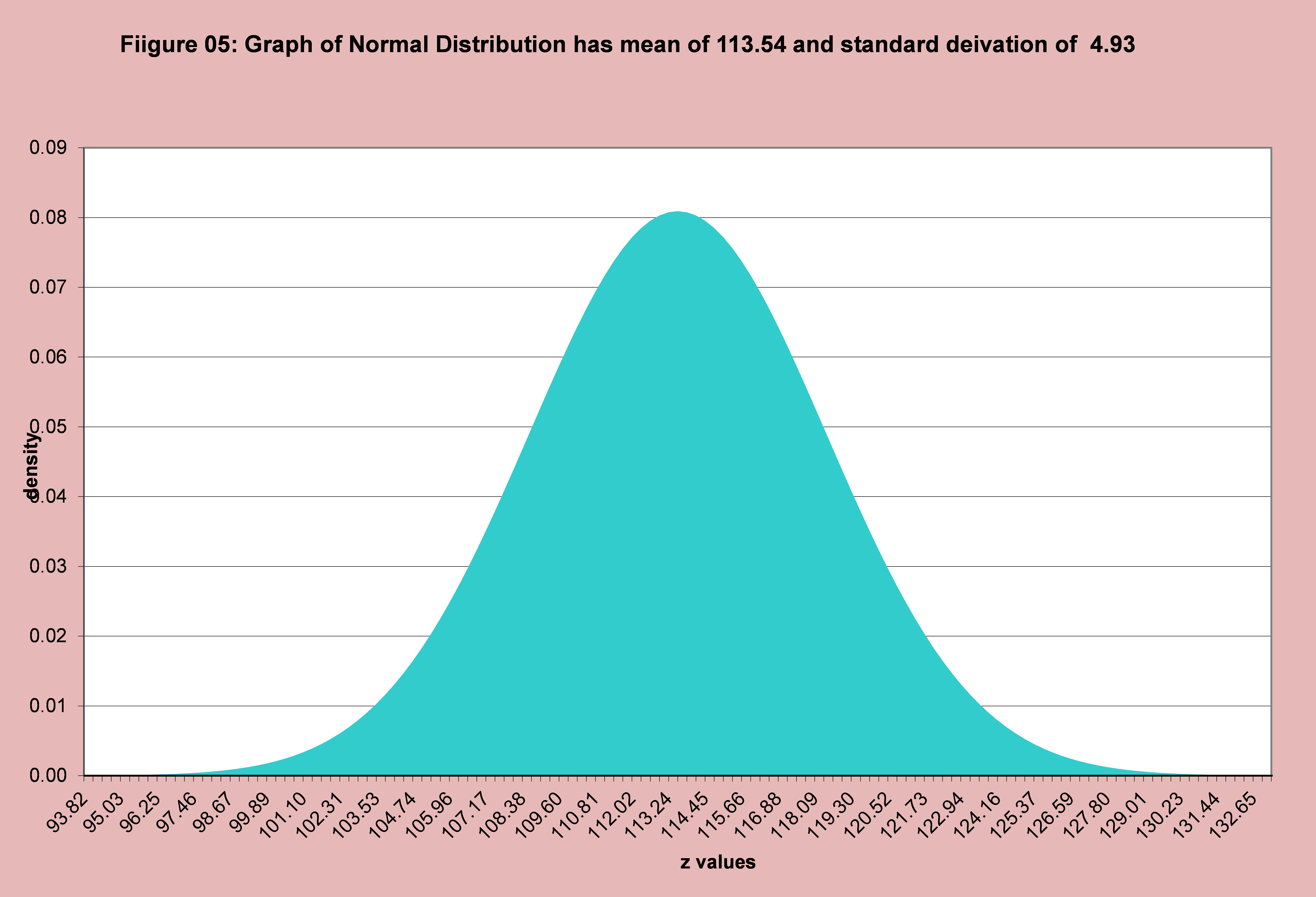
This is an example of the Central Limit Theorem (CLT) at work – as n gets sufficiently large, the total demand over n days, given the IID conditions, will morph to a normal distribution where the mean of this normal distribution is n times the average daily demand and the standard deviation is the square root of n times the standard deviation of demand for a single day. Figure 05 shows the normal distribution when the mean is 113.540 and the standard deviation is 4.930.
The magic question how large does n need to be to use the normal as a reasonable approximation of the distribution of total demand over n days?\ It depends on how “ugly” the daily distribution is, the level of precision required, and what fill rate is desired. Now you might have heard the magic number “30”. If n is greater than 30, then assuming the normal distribution is correct – “TILT” – not correct. The value of 30 has to do whether one uses the student T distribution or normal distribution for confidence intervals. That is not relevant to this discussion. Of course it sounds nice and the consultant or software vendor might attempt to use this when you ask them. If some it might be time for a new source of support.
Table 10: All Possible Options for Total Demand for Two Days with Probability where Demand for One Day is Specified in Table 01

How do we get to the safety stock equation - safety stock= Z_fr×√n×σ\ Our ice cream store owner wants to investigate a replenishment period of 30 days and is willing to use the normal distribution to approximate the distribution of total demand over the 30 day periods. From statistics gift 1, we calculate:
- Average total demand for 30 days is 486.6 = 30 x 16.22
- Standard deviation for 30 days is 10.205 = √30 x 1.863 = 5.477 x 1.863
Figure 05 has the normal approximation of the distribution of total demand for the replenishment period of 30 days with a mean of 486.6 and standard deviation of 10.205.
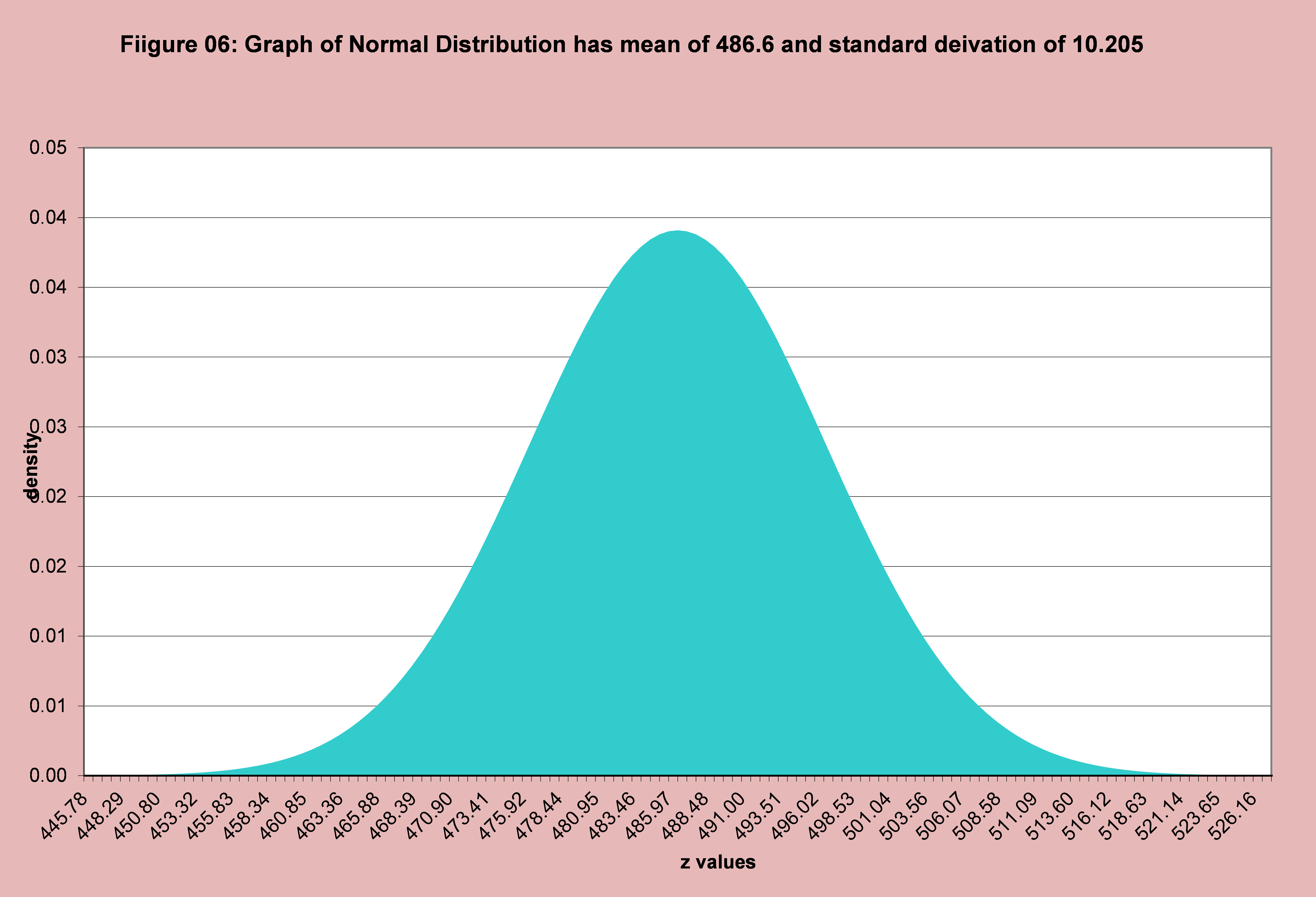
The owner now asks how much inventory is needed to be in stock at the start of the replenishment period to have a fill rate of 0.90. Before we looked at the table to find the demand value with the smallest cumulative probability value greater than 0.90. We have no such table. The normal is a continuous probability distribution, not a discrete distribution. In a continuous distribution the list of options for demand is all values between a start and end value. To adjust for this, we can only talk about the probability of demand occurring between a start value and end value and this probability is the area under the curve. The total area under the curve is 1, so any subsection of area has a value between 0 and 1. The smaller the area, the lower the probability.
To answer the owner’s question we need find the demand value so the area under the curve from left to this point is 0.90 and from this point to the right the area is 0.10. Figure 07 identifies this value as 499.68. This is how much stock must be on hand at the start of the replenishment period. The safety stock is 13.08(=499.68 – 486.6)
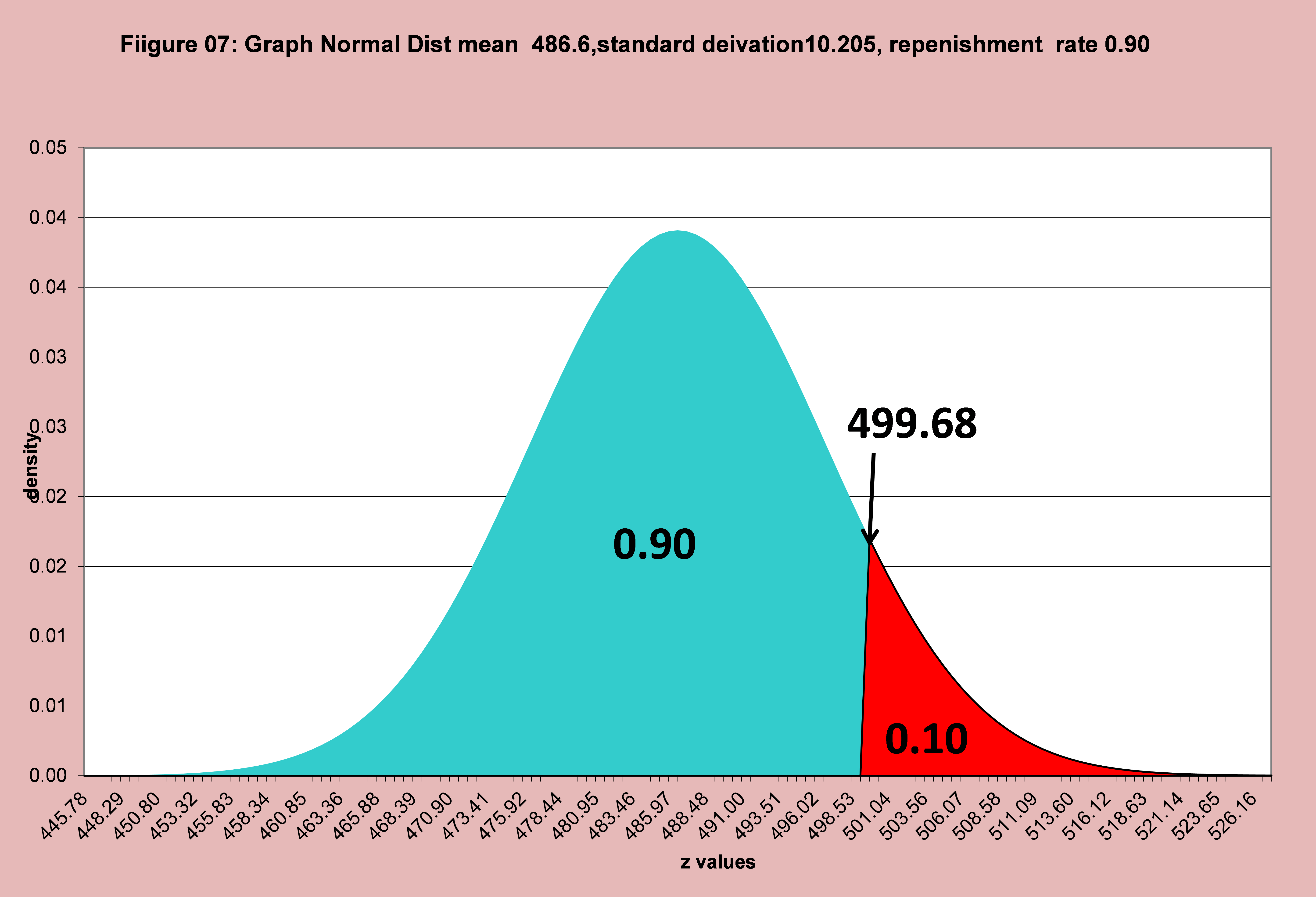
How did we get the value of 499.68?\ For a given mean and standard deviation, the inventory level for a given refill rate (success probability) is: mean + {Z(for refill rate)x standard_ deviation}. Where Z is the value for the standard normal (figure 01) which has 90% of the area to the left of this value and 10% to the right. This value can be found in table or statistics software. In Excel the syntax is norm.s.inv(0.90) and the Z value is 1.2816. We have:\ 499.68 = 488.6 + 1.2815 x 10.205
- If we put back in the average daily demand and standard deviation we get\ 499.68 = (30 x 16.22) + 1.2815 x √30 x 1.863
- Since safety stock is the desired inventory level minus average demand, the safety stock is\ 13.08 = 1.2815 x √30 x 1.863
Putting the math symbols back in we get safety stock= Z_fr×√n×σ, where:
- Z is the value of Z for the specified fill rate
- n is the number of days in the replenishment period
- σ is the standard deviation of the daily demand
Final Comment\ The material presented in the previous sections provides unravels the mystery of one part of inventory management - managing the risk of not meeting demand even when there is no uncertainty in replenishment. It sets out the core questions, defines terms, develops the core calculations, and identifies when the normal distribution will be work and how it will work.
Part 2 will demonstrate how variability in replenishment lead time is incorporated into the mix of calculations. Part 3 will look at a simple network of inventory points.
Inventory is a huge and critical area that cannot be treated separately from other areas of S\&OP such as demand management and supply planning – key areas include demand variability, demand classes, and smoothing or load leveling production. In fact one director of manufacturing I know saw inventory management, especially the flexibility associated with line side stocking and build to forecast, as key tools for smoothing production and absorbing variations in yields. These are topics for later sections.
Inventory: “Buffer Zone Dance” between Supply Folks and Demand Folks
Incorporating variation in replenishment lead time – the JOURNEY
In part 1, using the ice cream store example as our primary vehicle, we provided insight into the basics of understanding total inventory required to cover demand for a period n (1, 2, …30 …) days, accounting for variability in the daily demand. From this, we identified what portion of this demand would be classified as safety stock and how to use this information to make an informed decision. Last, we demonstrated when n is sufficiently large, then the normal distribution is a good approximation of total demand over n days independent of the distribution of daily demand applying the 8th wonder of the world – Central Limit Theorem (CLT).
Throughout all of part 1, the assumption made was there was ZERO variation in replenishment lead time. The condition was, a replenishment order was placed at the end of the day after the store was closed and the owner was certain the new 5 gallon containers of vanilla ice cream would be in the freezer before the first customer arrived the next day. The purpose of part 2 of the mystery tale is “how to handle uncertainty or variability in the lead time.
Quick Review of Ice Cream Business – Rules of Replacing Inventory & Daily Demand\ Our business is a small ice cream store that only sells its famous vanilla ice cream in five gallon units. When the store needs to refill its supply of vanilla ice cream, the order can be placed at night after the store closes and the new supply is delivered well before the store opens the next day without fail. The store can, if it wants to, reorder or replenish every night, every two nights … every 10 nights. In terms of quantity, the store can reorder between 1 and 9,999 units each time it places a replenishment decision. The owner believes the probability of a certain demand on any day is as given in Table 1. For this article, we will accept this as given. The complexity of generating this information is a topic for another time.
Table 01: Probability of Each Demand

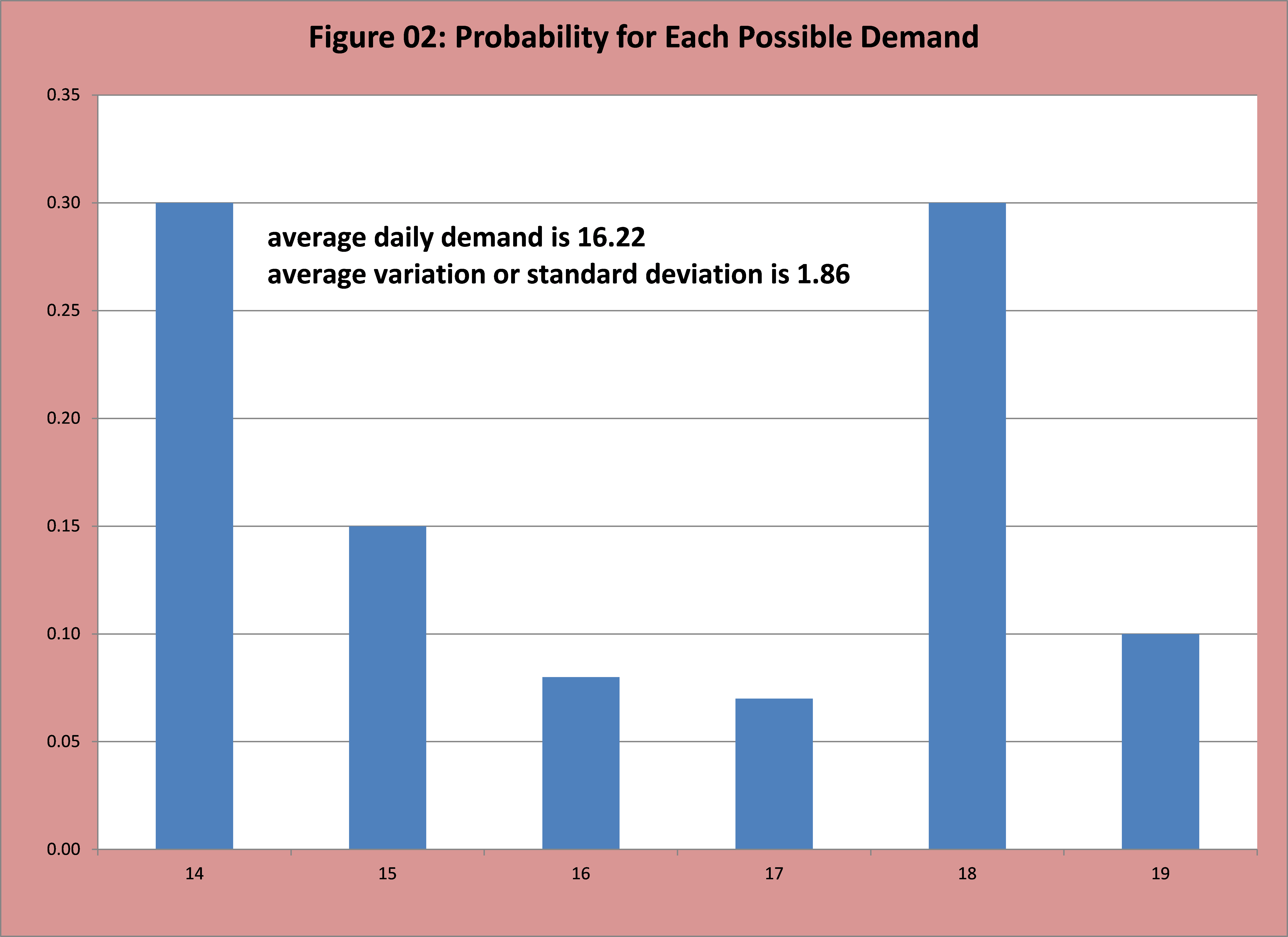
The “index” column is the identifier for each of the six possible demands. The “demand” column is the possible demand for a specific day, which is 14 to 19. Probability is the probability of exactly that demand on a given day. For example, the probability that daily demand is 16 is 0.08. Cumulative probability is the probability of demand for a specific day is the value for that row or less. The probability that the demand is 15 or less is 0.45(=0.30 + 0.15) which equals the probability the demand for the day is 15 (p=0.15). The “sum” row has the value 1; the sum of the probabilities for each possible demand must be 1. Figure 2 is graph of the “PDF” – the probability distribution function – the probability of each demand. The average daily demand is 16.22 and average variation (standard deviation) is 1.86
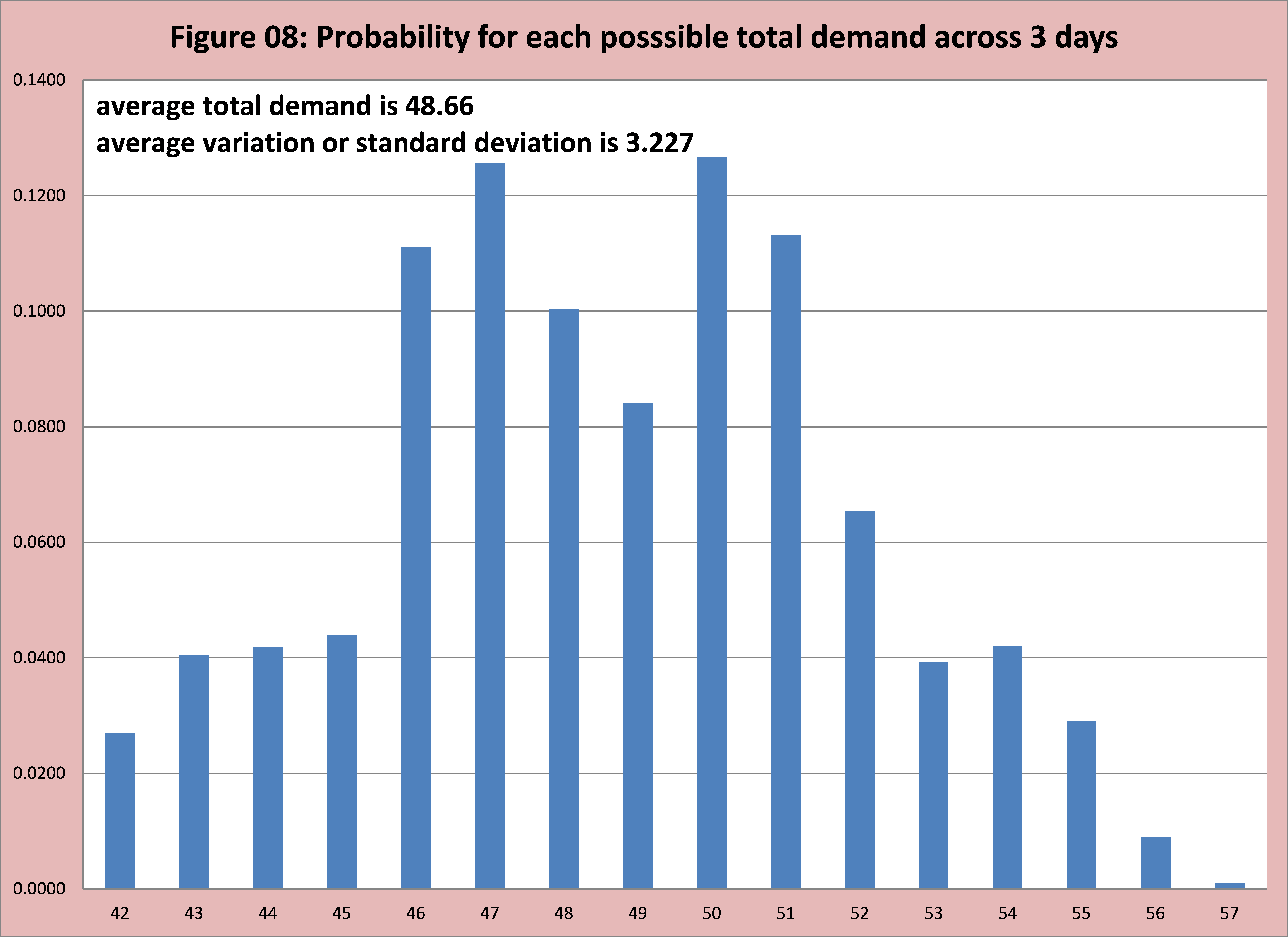
Replenishing Inventory Every Three Days with 0.90 Fill Rate\ After working with the store’s analytics team, the owner had decided to replenish inventory every third day with a fill rate of 0.90. Table 11 and Figure 08 have the distribution of total demand for three days using the computational mechanism described in Part 1. This information, along with estimates for inventory holding cost, reorder costs (transport, people, etc.) shelve life, cost for unmet demand, and others were analyzed with other models to support this decision.
Table 11: All possible options for total demand for three days with probability where demand for one day is specified in Table 01

Replenishing Inventory Every Three Days Accounting for Uncertainty in Delivery\ With the basic decisions in place for inventory and the establishment of a regular process for replenishing inventory in an orderly fashion, the owner now asks the next logical question in the journey: What if the delivery of ice cream is delayed one day?
The owner goes to the ace analytics team, asks them for the analysis, and provide the owner a solution they can understand; all by Friday.
The lead of his analytics team, having read the great works of Gene Woolsey, comes up with the following solution:
- The vast majority of the time, when the order is placed at night, it arrives the next morning. Since an order is placed one every three days, the key calculation is finding the probability distribution of total demand for 3 days.
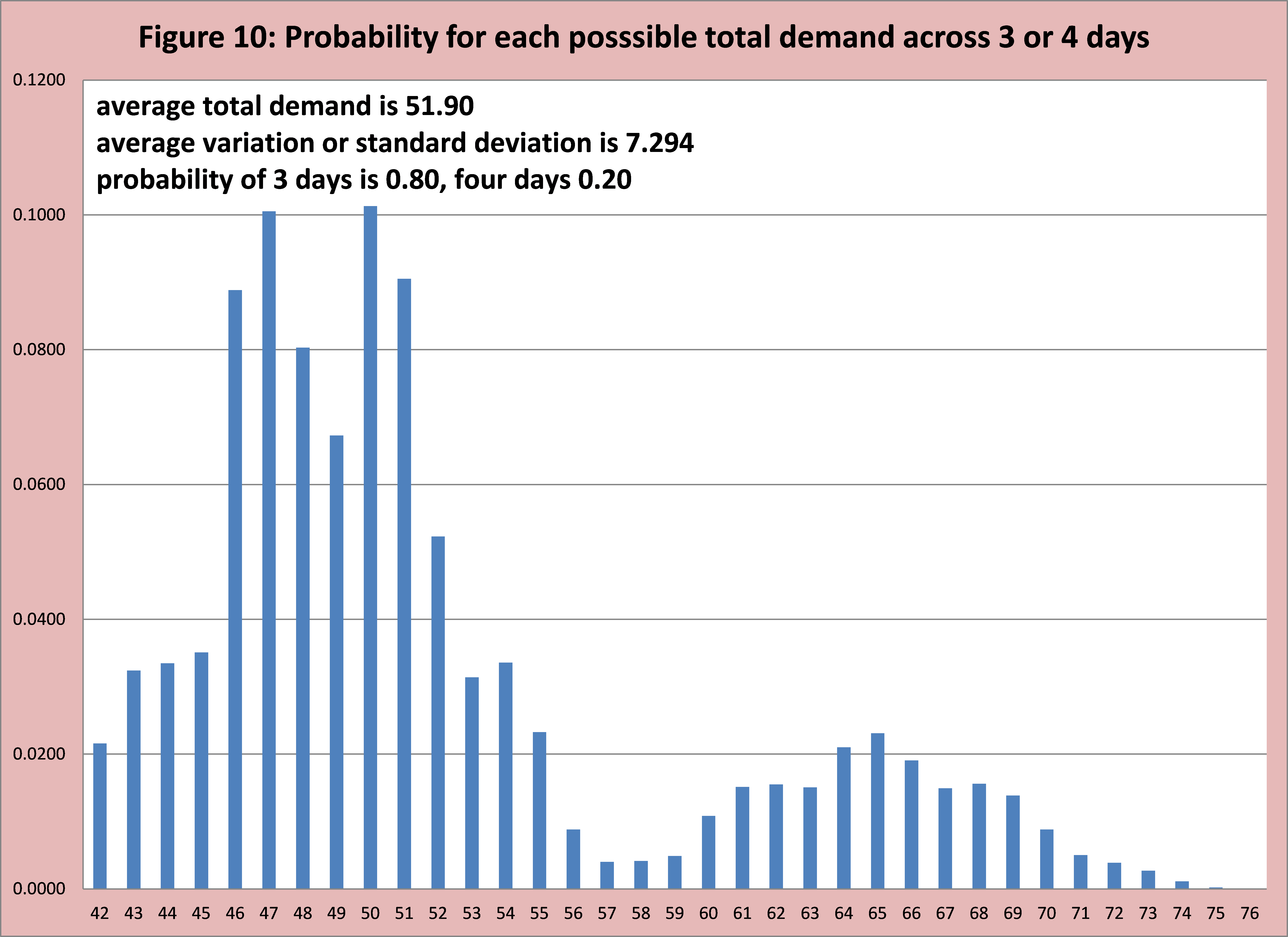
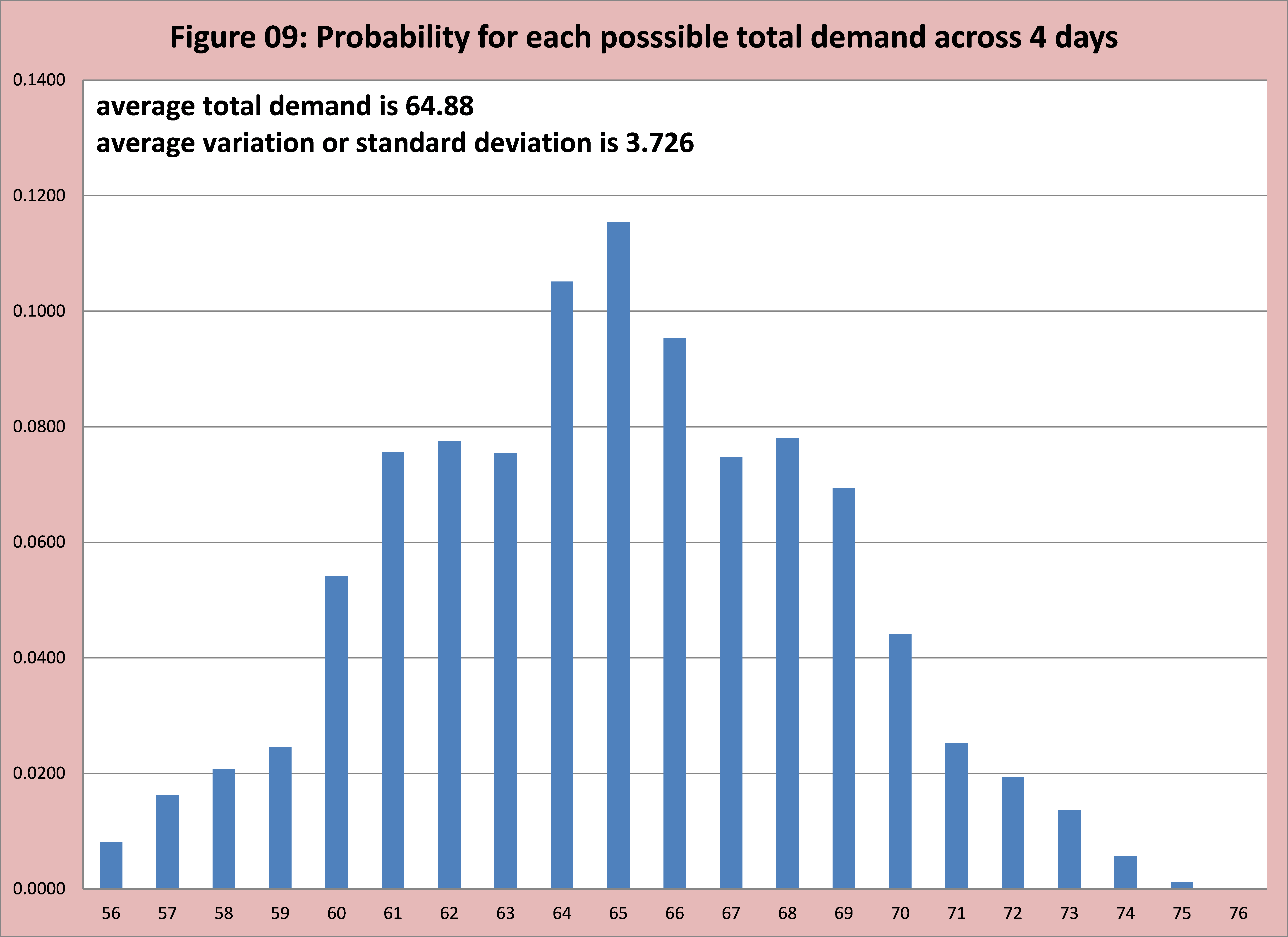
- If the truck is delayed one day, that is the equivalent of having to know the probability distribution of total demand for four days. This can be calculated using the same method already established. Table 12 and Figure 09 have this information in Appendix 1.
- The question becomes how to combine this information in a way that can be understood and works (this is called mixture problem in the literature – as well going under some other names).
- The lead starts with the assumption the truck will arrive on time 80% (0.80) of the time. It will arrive one day late 20% (0.20) of the time.
- Step 1 – the lead multiplies the probability distribution of total demand for 3 days by 0.80 and the probability distribution of total demand for four days by 0.20. This information is displayed in Tables 13 and 14. The lead quickly notices the column total for the probability of each event multiplied by 0.80 in Table 13 is 0.80, similarly 0.20 in Table 14.
- After a bit of thought, the lead realizes whether the truck arrives on time or one day late is independent of the demand on the store.
- The lead reframes the question as follows: 'What is distribution of demand on the store just after the replenishment delivery has arrived?, which brings the total inventory to target level until the next arrival of inventory, where the next arrival is either in three days or four day where the probability of three days is 0.80 and four days is 0.20.
- This distribution, that is the probability of different levels demand or this period with a variable end point (3 days or 4 days), is simply the weighted average of the probability distribution of total demand for three days with its equivalent for 4 days.
- Step 2 is simply noting all possible options is the unique set of demand values between Table 13 and Table 14 and combining (adding) probabilities where a value is in both tables.
- For example the values 42 to 55 can only be found in Table 13. The values 58 to 76 can only be found in Table 14. The value 56 and 57 are in both tables.
- Table 15 and Figure 10 has the results of this combination or mixture work.
This story has a happy ending, the owner is happy and now trusts the analytics lead to finish the work – there some other substantial complexities. A topic for another time.
Table 13: All possible options for total demand for three days with probability where demand for one day is specified in Table 01, then multiplied by 0.80

Table 14: All possible options for total demand for four days with probability where demand for one day is specified in Table 01, then multiplied by 0.20

Table 15: All possible options for total demand between replenishment, when the probability it is 3 days 0.80 and 4 days is 0.20

Appendix 1: Distribution of Total Demand for 4 Days\ Table 12: All possible options for total demand for four days with probability where demand for one day is specified in Table 01

Related Articles
Inventory Planning Introduction
Arkieva’s sophisticated analysis tools and safety stock reports enable planners to identify inventory issues and to make informed decisions concerning this delicate inventory balancing act. Our Inventory Planner utilizes demand data to plan safety ...Inventory Management
Basics of Inventory This inventory basics video will help you understand inventory management frameworks. We will help you think about inventory policies, whether something is made to stock or whether something is lean / agile, and what kind of ...Inventory Definitions
Basic Definitions Standard Deviation Used to quantify the amount of variation of a set of data values from its mean. Where,\ σ = Standard Deviation\ Xi = Data observations\ µ = Mean of Xi observations\ N = Number of observations if number of ...Inventory Planner
The Arkieva Inventory Planner (IP) supports sustained inventory reductions by providing a comprehensive view of how stocks are serving customer demand. The Inventory Planner is closely linked with the Demand Planner and the Supply Planner. Reports ...Replenishment Planner
The Replenishment Planner is a multi-echelon planning solution that ensures that the right quantity and mix of products are shipped to the right location, at the right time. The Replenishment Planner uses a proprietary, sequential rule-based ...