Forecasting Terms
Time Series
Any set of data which is described in terms of time. Examples:
- Corona Virus cases every day/week/month, etc.
- Sales of a smart phone over months/quarter, etc.
Time Series forecasting
Identifying patterns in the past and projecting them out into the future. For example in the below COVID-19 Cases by Day chart you can see 2 patterns:
- There is an increasing trend of cases (indicated by black arrow) and,
- the number of cases go up and down every 7 days.
COVID-19 Cases by Day
Causal forecasting
The word 'Causal' comes from the word 'because'. Some external factors over and above historical patterns cause something. As an example, the number of COVID-19 cases going up or down because of demography or health care facilities, etc.
Recency
Comes from the word 'recent' - what happened in the near past.
Cycles
A series of events that repeat in the same order. For example:
- Seasons which repeat every 4 months. So the cycle for 1 season is 12 months.
- Number of Amazon shipments is highest every Monday. Cycle is 1 week or 7 days.
Leading zeros
Zeroes at the beginning of a time series data. For example, if iPhone 11 started selling in July 2019 and in July 2020 we consider 36 months of history then we have leading zeroes from July 2017 until June 2019; i.e. for first 24 months.
📘 Note
We always want to ignore leading zeroes for forecasting because we assume that the product did not exist back then.
Trailing zeros
In Arkieva we use the Segmentation module to figure out these leading or trailing zeroes using the Trend Measure. For example the iPhone 8 sales in the same 36 months from July 2017 to July 2020. We might have some sales at the beginning until December or January 2017 but then the sales hit 0 and stayed at 0. Such data is called trailing zeroes.
🚧 Exception: Highly Seasonal demand
For example, New Years Cards which sell only between November to January and then no sales until next November.
Weighting
How much weight we assign to a data set; typically heavier weight is assigned to recent data.
🚧 Exceptions: Seasonal and Outlier
In the case of New Years Cards if we assign higher weightage to the months of December and January we will get a forecast for the immediate months of February, March, etc., which does not make business sense.
In cases of outliers such as the COVID-19 pandemic, if a medicine is invented and the disease disappears then we don't want to assign heavy weight on recent months.
Outliers
Examples of outliers include demonetization which impacted businesses in India and pandemics like COVID-19.
Noise
Unwanted data. In the below charts, the weekly chart has a lot of noise (too much variation) compared to the Monthly chart.
Compared to the Daily chart the Weekly chart looks cleaner and it is much easier to identify a pattern in the Weekly chart. We see cases increasing every week.
Same COVID-19 data in Weekly buckets
Aggregation and Accuracy
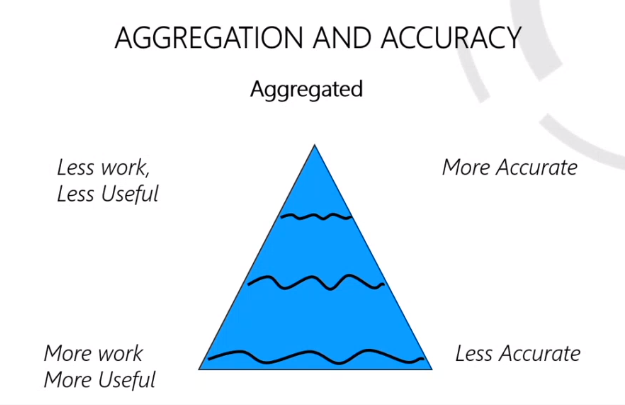
Aggregation levels of forecasting is related to the forecast accuracy measured at that level. Below is a representation of this relationship. At lower levels of aggregation, the number of calculations will be more and the results will be more useful, but the noise level is also more. This means less accurate results. Now on the other side at higher levels of aggregation, the forecast calculations are less and the results will be less useful. But the accuracy of forecasting will be high at higher levels since the noise levels are lower.
Examples:
- Low level data such State or City level is noisy
- More aggregated data such as at Region level or Country level is less noisy
- More computing power is required for number crunching at low level
- City level forecast is more useful in shipping hospital beds or doctors rather then country level forecast
Density of matrix
Density of matrix is the percentage of combinations a company needs to forecast.
- Density of matrix = Active Combinations divided by Maximum combinations
If a company sells 200 products and has 100 customers, the maximum combinations is 200 * 100 = 20,000 combinations. Assuming the Active Combinations = 2,000 combinations, the density of matrix = 10%. In B2B world, generally 10% is the density of matrix.
While doing a Demand Planning implementation, we should compute the Density of Matrix
Window Error
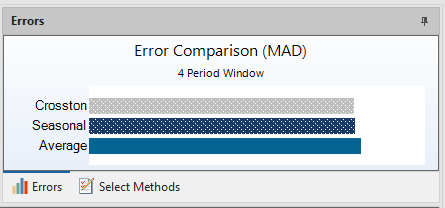
An error calculated in the window as reported in the error comparison graph in the statistical forecast tab.
Training Error
Error calculated in the code during the various forecast runs, but is not displayed anywhere in the GUI.
Fitted Data vs. Forecasted Data
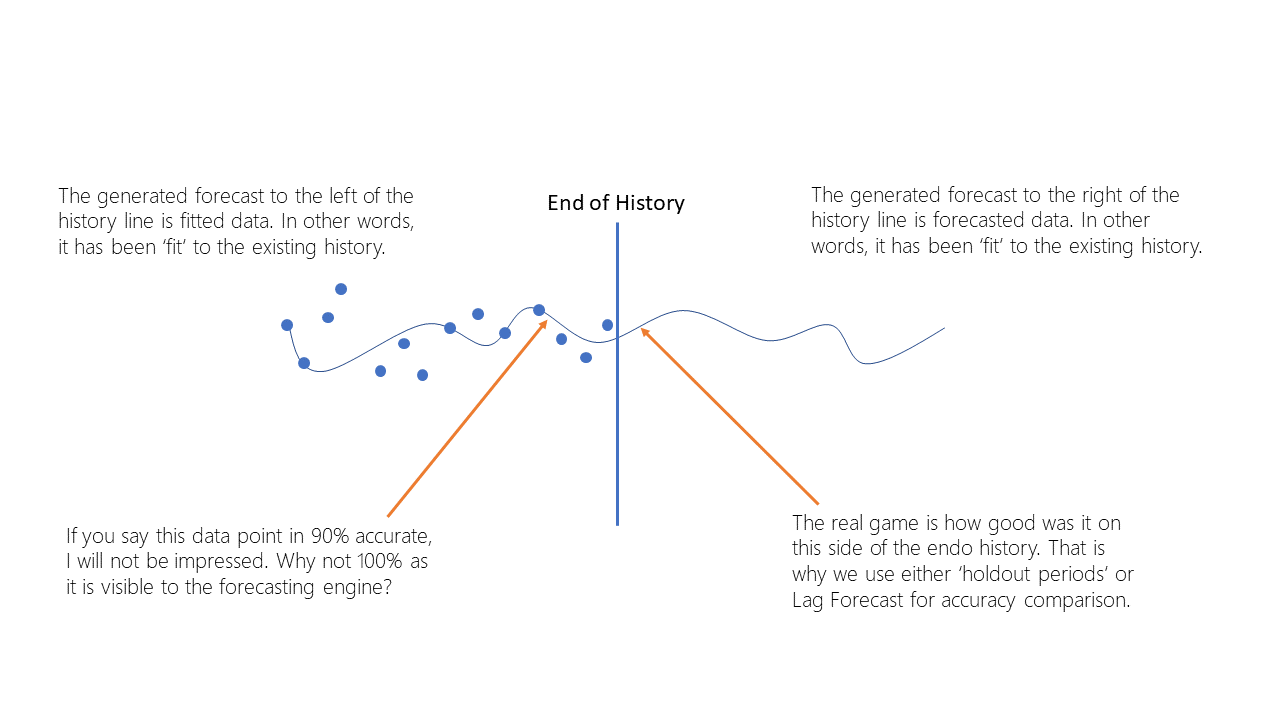
History is typically divided into Testing Data and Training (or hold out) Data.
Testing Data\ Data that is used to generate the forecast and check for performance against the training data that is withheld from the engine, but where we know what happened.
Training (or hold out) Data\ This is part of the history where we see how good or bad a job a particular method is doing. This is controlled by the Windows parameter.
Related Articles
Causal Forecasting
Causal methods When time series methods use time series history to forecast the future, Causal forecasting methods factor for the time series data and external factors that would influence the forecast. The external factor(s) that influence the ...Financial Planner
Introduction Increasingly, our customers would like to tie-in financial metrics to their operational plans. To accomplish this, we have incorporated strategic benchmarking into the Arkieva platform so that we can design the operational supply chain ...Forecast Performance
The following is a list of Performance Metrics. Bias Total bias shows how many units your forecast is deviating from the actual sales values in absolute terms and whether the forecast is biased towards overestimating or underestimating the actual. ...Methodology
Arkieva has the flexibility to use multiple formulas in a forecasting method. It also gives configurable options to combine/compare the results of each formula and calculate a final forecasting result. When selecting more than one method, Arkieva ...Demand Planning Introduction
The Demand Planner creates a collaborative demand planning process for a cross-functional demand planning process for working towards one common goal. Benefits of the Arkieva Demand Planner Solution: 15% less inventory 17% higher perfect order ...